

調べた例文を記録して、効率よく覚えましょう
Weblio会員無料で登録できます
 履歴機能
過去に調べた単語を確認できる
履歴機能
過去に調べた単語を確認できる
 語彙力診断
診断回数が4回に増加
語彙力診断
診断回数が4回に増加
 マイ単語帳
便利な学習機能付き
マイ単語帳
便利な学習機能付き
 マイ例文帳
文章で意味を理解できる
マイ例文帳
文章で意味を理解できる

Wiktionary英語版
出典:Wiktionary
accumulation point
出典:『Wiktionary』 (2024/08/08 18:22 UTC 版)
名詞
accumulation point (plural accumulation points)
- (topology, "of" a subset of a topological space) Given a subset S of a topological space X, a point x whose every neighborhood contains at least one point distinct from x that belongs to S.
- 2008, Brian S. Thomson, Andrew M. Bruckner, Judith B. Bruckner, Elementary Real Analysis, Volume 1, Thomson-Bruckner (ClassicalRealAnalysis.com), 2nd Edition, page 153,
- Definition 4.9 (Closed): The set E is said to be closed provided that every accumulation point of E belongs to the set E.
- Thus a set E is not closed if there is some accumulation point of E that does not belong to E. In particular, a set with no accumulation points would have to be closed since there is no point that needs to be checked.
-
2016, Jonathan M. Kane, Writing Proofs in Analysis, Springer, page 74:
-
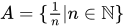
A set has an accumulation point if for every there is an with and . Informally, is an accumulation point of if there are points of that are arbitrarily close to . Note that the fact that is an accumulation point of the set has nothing to do with whether is actually an element of . For example, the set has one accumulation point, , because for every there is an with . Here the accumulation point is not an element of the set .
-
- (mathematical analysis, "of" a sequence) Given a sequence si, a point x whose every neighborhood contains at least one element of the sequence distinct from x.
- Synonyms: cluster point, limit point
- (systems theory, dynamical systems, chaos theory) For certain maps, a point beyond which periodic orbits give way to chaotic ones.
-
1995, Milos Marek, Igor Schreiber, Chaotic Behaviour of Deterministic Dissipative Systems, Cambridge University Press, page 77:
-
The chaotic set (not necessarily attracting) is formed after the first accumulation point ( for the logistic mapping) is reached. In the chaotic region of the logistic map the periodicity re-emerges in periodic windows which are bounded by the accumulation point from the right and by the saddle-node bifurcation from the left. A reverse bifurcation sequence occurs above the accumulation point.
-
-




使用する際の注意点
- If X is a T₁ space (a broad class that includes Hausdorff spaces and metric spaces), then the set of points in S in each neighborhood of an accumulation point x is at least countably infinite.
- If each neighborhood's intersection with S is uncountably infinite, the term condensation point can be used. Terms such as -accumulation point (or -accumulation point) and -accumulation point may also be used.
- The term complete accumulation point may be used if the cardinality of the set of points in any given neighborhood of x that are also in S is equal to the cardinality of S.
- The sequence case can be regarded as a particular instance of the topological definition. For a sequence of real numbers, for instance, the topological space is the real number line (equipped with an order topology provided by the absolute value metric), of which the sequence is subset. If the sequence has a limit, it must be an accumulation point. (But note that a sequence may have more than one accumulation point.)
- Consequently, both cases can be explained and discussed in similar mathematical language.


反意語
- isolated point
上位語
- limit point
下位語
- condensation point
派生語
- complete accumulation point
参考
- limit set
Further reading
 Accumulation point on Wikipedia.Wikipedia
 - Accumulation point on Encyclopedia of Mathematics
- Accumulation Point on Wolfram MathWorld




- All Rights Reserved, Copyright © Japan Science and Technology Agency

- Copyright © 2026 CJKI. All Rights Reserved
- Wiktionary
- Text is available under Creative Commons Attribution-ShareAlike (CC-BY-SA) and/or GNU Free Documentation License (GFDL).
Weblio英和・和英辞典に掲載されている「Wiktionary英語版」の記事は、Wiktionaryのaccumulation point (改訂履歴)の記事を複製、再配布したものにあたり、Creative Commons Attribution-ShareAlike (CC-BY-SA)もしくはGNU Free Documentation Licenseというライセンスの下で提供されています。
