


調べた例文を記録して、効率よく覚えましょう
Weblio会員無料で登録できます
 履歴機能
過去に調べた単語を確認できる
履歴機能
過去に調べた単語を確認できる
 語彙力診断
診断回数が4回に増加
語彙力診断
診断回数が4回に増加
 マイ単語帳
便利な学習機能付き
マイ単語帳
便利な学習機能付き
 マイ例文帳
文章で意味を理解できる
マイ例文帳
文章で意味を理解できる
Wiktionary英語版
出典:Wiktionary
ordered ring
名詞
ordered ring (複数形 ordered rings)
- (algebra, order theory, ring theory) A ring, R, equipped with a partial order, ≤, such that for arbitrary a, b, c ∈ R, if a ≤ b then a + c ≤ b + c, and if, additionally, 0 ≤ c, then both ca ≤ cb and ac ≤ bc.
- 1965, Seth Warner, Modern Algebra, Dover, 1990, Single-volume republication, page 217,
- If is an ordering on compatible with its ring structure, we shall say that is an ordered ring. An element of an ordered ring is positive if , and is strictly positive if .
- The set of all positive elements of an ordered ring is denoted by , and the set of all strictly positive elements of is denoted by .
- If is an ordered ring and if is a total ordering, we shall, of course, call a totally ordered ring; if is a field, we shall call an ordered field, and if, moreover, is a total ordering, we shal call a totally ordered field.
- 1990, P. M. Cohn, J. Howie (translators), Nicolas Bourbaki, Algebra II: Chapters 4-7, [1981, N. Bourbaki, Algèbre, Chapitres 4 à 7, Masson], Springer, 2003, Softcover reprint, page 19,
- DEFINITION 1. — Given a commutative ring , we say that an ordering on is compatible with the ring structure on if it is compatible with the additive group structure of , and if it satisfies the following axiom:
- (OR) The relations and imply .
- The ring , together with such an ordering, is called an ordered ring.
- Examples. — 1) The rings and , with the usual orderings, are ordered rings.
- 2) A product of ordered rings, equipped with the product ordering, is an ordered ring. In particular, the ring of mappings from a set to an ordered ring is an ordered ring.
- 3) A subring of an ordered ring, with the induced ordering, is an ordered ring.
- 1965, Seth Warner, Modern Algebra, Dover, 1990, Single-volume republication, page 217,
- (algebra, order theory, ring theory) A ring, R, equipped with a total order, ≤, such that for arbitrary a, b, c ∈ R, if a ≤ b then a + c ≤ b + c, and if, additionally, 0 ≤ c, then both ca ≤ cb and ac ≤ bc.
- 2013, Jonathan K. Hodge, Steven Schlicker, Ted Sundstrom, Abstract Algebra: An Inquiry Based Approach, CRC Press, page 253,
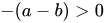
- The positive elements in an ordered ring allow us to compare elements to 0, but we know in the integers that we can compare any two elements to each other. For example, we know that because . We can extend this idea to any ordered ring. If is an ordered ring and , then we know by trichotomy that exactly one of the following must be true: , , or .
- 2014, Benjamin Fine, Anthony M. Gaglione, Gerhard Rosenberger, Introduction to Abstract Algebra, Johns Hopkins University Press, page 77,
- Definition 3.5.4. A ring is an ordered ring if there exists a distinguished set , , called the set of positive elements, with the properties that:
- (1) The set is closed under addition and multiplication.
- (2) If then exactly one of the following is true: (trichotomy law)
- (a) ,
- (b) ,
- (c) .
- If further is an integral domain we call an ordered integral domain.
- […]
- Lemma 3.5.9. If is an ordered ring and is a positive element, then the set .
- […]
- Theorem 3.5.2. An ordered ring must be infinite.
- Definition 3.5.4. A ring is an ordered ring if there exists a distinguished set , , called the set of positive elements, with the properties that:
- 2013, Jonathan K. Hodge, Steven Schlicker, Ted Sundstrom, Abstract Algebra: An Inquiry Based Approach, CRC Press, page 253,





使用する際の注意点
- While the ring is, strictly speaking, not necessarily associative or commutative, it may be defined as either or both by authors working within an overarching theory.
- The property in the definition is sometimes replaced by the equivalent .
- The order is said to be compatible with the ring structure of (in the sense that order is preserved by addition かつ, to an extent, multiplication).
- A partial order is a total order if and only if the trichotomy condition holds: in other words, , where is the positive cone of and .
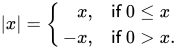
- Consequently, in the total order case, it makes sense to define an absolute value applicable to every element of :





同意語
- (ring equipped with a partial order): partially ordered ring
- (ring equipped with a total order): totally ordered ring
下位語
- (both senses): discrete ordered ring (= discretely ordered ring), ordered field
派生語
- lattice-ordered ring
Further reading
- Linearly ordered group on Wikipedia.
- Ordered ring on Encyclopedia of Mathematics
ウィキペディア英語版
出典:Wikipedia
Ordered ring
出典:『Wikipedia』 (2010/10/31 17:04 UTC 版)
英語による解説
ウィキペディア英語版からの引用
- 引用
In abstract algebra, an ordered ring is a commutative ring R with a total order ≤ such that for all a, b, and c in R:
- Wiktionary
- Text is available under Creative Commons Attribution-ShareAlike (CC-BY-SA) and/or GNU Free Documentation License (GFDL).
Weblio英和・和英辞典に掲載されている「Wiktionary英語版」の記事は、Wiktionaryのordered ring (改訂履歴)の記事を複製、再配布したものにあたり、Creative Commons Attribution-ShareAlike (CC-BY-SA)もしくはGNU Free Documentation Licenseというライセンスの下で提供されています。
- Wikipedia
- Text is available under Creative Commons Attribution-ShareAlike (CC-BY-SA) and/or GNU Free Documentation License (GFDL).
Weblio英和・和英辞典に掲載されている「Wikipedia英語版」の記事は、WikipediaのOrdered ring (改訂履歴)の記事を複製、再配布したものにあたり、Creative Commons Attribution-ShareAlike (CC-BY-SA)もしくはGNU Free Documentation Licenseというライセンスの下で提供されています。
