

調べた例文を記録して、効率よく覚えましょう
Weblio会員無料で登録できます
 履歴機能
過去に調べた単語を確認できる
履歴機能
過去に調べた単語を確認できる
 語彙力診断
診断回数が4回に増加
語彙力診断
診断回数が4回に増加
 マイ単語帳
便利な学習機能付き
マイ単語帳
便利な学習機能付き
 マイ例文帳
文章で意味を理解できる
マイ例文帳
文章で意味を理解できる
Weblio英和対訳辞書

Primitive polynomial (field theory)
原始多項式
数学の一分野である体論における原始多項式(げんしたこうしき、英: primitive polynomial)とは,有限体の拡大体 GF(pm)の原始元の最小多項式のことである. すなわち,GF(p) = Z/pZの元を係数とする次数 m の多項式 F(X) が, GF(pm) の原始元 α を根に持つ(つまり,F(α)=0 となる)とき,F(X) は原始多項式である. ここで,GF(pm)の原始元とは,体 GF(pm) において,集合 {0, 1, α, α2, α3, ..., αpm-2} が GF(pm) 自身と等しくなる元 α であり,GF(pm)における単位元1の (pm - 1)乗根である. 全ての最小多項式は既約であるから,原始多項式は既約である. 原始多項式の定数項の係数は非零でなければならない.そうでないと,多項式 x で割り切れてしまう. GF(2)においては,x + 1 は原始多項式であるが,それ以外の全ての原始多項式は奇数個の項を持つ.なぜなら,偶数個の項を持つ多項式は,mod 2 では必ず多項式 (x + 1) で割り切れてしまう(すなわち x= 1 を根として持つ). p が素数であるとき,GF(p) 上の m 次の既約多項式 F(x) が原始多項式であるための条件は, xn - 1 がF(x) で割り切れるような 最小の正整数 n が n = pm -1であることである. GF(p) 上の m 次の原始多項式は,ちょうど φ(pm - 1)/m 個存在する.ただし,φ はオイラーのφ関数である. m 次の原始多項式は,GF(pm) において m 個の異なる根を持ち,全ての根の位数は pm - 1である.すなわち,α が根であるならば,αpm-1 = 1 かつ 全ての i = 1, 2, ... ,pm - 2 においてαi ≠ 1 が成り立つ. GF(pm) における原始元 α が,m 次の原始多項式 F(x) の根であるならば,この多項式は F(x) = (x - α)(x - αp)(x - αp2)...(x - αpm-1) で書き表せる. 原始多項式は, 有限体の元を表現するのに用いられる.もし GF(pm) の元 α が 原始多項式 F(x) の根ならば,α の位数は pm - 1 であり,全ての GF(pm) の(0以外の)元は α のべき乗で表すことができる.つまり, これらの元を多項式F(α)で割った余りを取ると,体の全ての元の多項式基底表現が得られる. 有限体の乗法群は常に巡回群であるため, GF(p)[x]/f(x) において, 原始多項式 f は,乗法群の生成元 x に関する多項式である. GF(2) 上の原始多項式は,線形帰還シフトレジスタ(LFSR)を用いた疑似ランダムビット生成に利用できる.レジスタ長が n のLFSRの周期は最長で 2n - 1 であるが、全ての最長周期のLFSRは原始多項式を使って構築できる. 例えば,原始多項式 x10 + x3 + 1 が与えられたとき,まずユーザが決めた10ビットのシード(全てが0であるものを除く)から始める.右から順に1番目のビット,2番目のビット,...,10番目のビットとする.ここで、シードはランダムに選ばれている必要はないが,ランダムでもよい.次に,10番目と3番目のビットの排他的論理和を計算し,これを0番目のビットとする.そして,10番目のビットを出力するとともに、シードのビットを1つずつ左へずらす。
Weblio英和対訳辞書はプログラムで機械的に意味や英語表現を生成しているため、不適切な項目が含まれていることもあります。ご了承くださいませ。
Wiktionary英語版
出典:Wiktionary
primitive polynomial
出典:『Wiktionary』 (2025/10/26 22:22 UTC 版)
名詞
primitive polynomial (plural primitive polynomials)

- (algebra, ring theory) A polynomial over an integral domain R such that no noninvertible element of R divides all its coefficients at once; (more specifically) a polynomial over a GCD domain R such that the greatest common divisor of its coefficients equals 1.
-
1992, T. T. Moh, Algebra, World Scientific, page 124:
-
We claim that every primitive polynomial can be written as a product of irreducible elements in . […] By induction on the degree of the primitive polynomials, we conclude that both can be written as product of irreducible elements in .
-
-
2000, David M. Arnold, Abelian Groups and Representations of Finite Partially Ordered Sets, Springer, page 114:
-
If , the ring of polynomials with coefficients in , then the content of , denoted by , is the greatest common divisor of the coefficients of . The polynomial is called a primitive polynomial if . Since , by Gauss's lemma [Hungerford, 74], the set of primitive polynomials in is a multiplicatively closed set. Define , the localization of at , a subring of the field of quotients of . Elements of are of the form with and a primitive polynomial.
-
-
2000, Jun-ichi Igusa, An Introduction to the Theory of Local Zeta Functions, American Mathematical Society, page 1:
-
According to the Gauss lemma, the product of primitive polynomials is primitive. Therefore if are primitive and with in , then necessarily is in and primitive. […] The irreducible elements of are irreducible elements of and primitive polynomials which are irreducible in .
-
-
- (algebra, field theory) A polynomial over a given finite field whose roots are primitive elements; especially, the minimal polynomial of a primitive element of said finite field.
-
2003, Zhe-Xian Wan, Lectures on Finite Fields and Galois Rings, World Scientific, page 145:
-
Definition 7.2 Let be a monic polynomial of degree over . If has a primitive element of as one of its roots, is called a primitive polynomial of degree over .
Theorem 7.7 For any positive integer there always exist primitive polynomials of degree over . All the roots of a primitive polynomial of degree over are primitive elements of . All primitive polynomials of degree over are irreducible over . The number of primitive polynomials of degree over is equal to .
-
-
2008, Stephen D. Cohen, Mateja Preŝern, “The Hansen-Mullen Primitivity Conjecture: Completion of Proof”, in James McKee, Chris Smyth, editors, Number Theory and Polynomials, Cambridge University Press, page 89:
-
This paper completes an efficient proof of the Hansen-Mullen Primitivity Conjecture (HMPC) when n = 5, 6, 7 or 8. The HMPC (1992) asserts that, with some (mostly obvious) exceptions, there exists a primitive polynomial of degree n over any finite field with any coefficient arbitrarily prescribed.
-
![{\displaystyle \mathbf {D} [x]}](https://wikimedia.org/api/rest_v1/media/math/render/svg/69e1aa3e695f295cbccad9ae1f5388f461ff1dee)

![{\displaystyle f(x)\in \mathbb {Z} [x]}](https://wikimedia.org/api/rest_v1/media/math/render/svg/cb8266c32dfc2904dc4331ea8906ad341a05ce1c)




![{\displaystyle \mathbb {Z} [x]}](https://wikimedia.org/api/rest_v1/media/math/render/svg/0d4da3ac703cc7721ebba91a53f6752de7157124)
![{\displaystyle \Lambda =\mathbb {Z} [x]_{S}}](https://wikimedia.org/api/rest_v1/media/math/render/svg/3f3aa85c728004cb3796bc0c8a492c8bbec1f601)


![{\displaystyle f(x),g(x)\in \mathbb {Z} [x]}](https://wikimedia.org/api/rest_v1/media/math/render/svg/7bcb52a09ca88f9067d648a6dd69ee73e76630a0)




![{\displaystyle F[x]}](https://wikimedia.org/api/rest_v1/media/math/render/svg/39bc9f9d8679fc385df3bccf9694283b796f3216)
![{\displaystyle A[x]}](https://wikimedia.org/api/rest_v1/media/math/render/svg/d7d5d3b3ae4cfb46d3ef305e5d7dcb130f10e468)


使用する際の注意点
- Since fields are rings, the domain of applicability of the ring theory definition includes that of the one specific to Galois fields. It is thus perfectly feasible for a given instance to be a primitive polynomial in both senses of the term: such is the case, for example, for the minimal polynomial (over a given finite field) of a primitive element (i.e., that has said primitive element as root).
- (polynomial over a finite field whose roots are primitive elements):
- More precisely, a primitive polynomial over (with coefficients in) of order has roots that are primitive elements of .
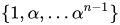
- Given a primitive element , the set of powers constitutes a polynomial basis of .
- In consequence, a primitive polynomial is sometimes defined as a polynomial that generates .

下位語
- (polynomial over an integral domain such that no noninvertible element divides all of its coefficients): monic polynomial
関連する語
- primitive part (of a polynomial)
参考
- content (of a polynomial)
- irreducible
- primitivity
Further reading
 Polynomial basis on Wikipedia.Wikipedia
 - Gauss's lemma (polynomial) on Wikipedia.Wikipedia
- Polynomial ring on Wikipedia.Wikipedia
- Primitive polynomial on Encyclopedia of Mathematics
- Galois field structure on Encyclopedia of Mathematics
- Primitive Polynomial on Wolfram MathWorld




- Copyright (c) 1995-2026 Kenkyusha Co., Ltd. All rights reserved.

- All Rights Reserved, Copyright © Japan Science and Technology Agency

- Copyright © 2026 CJKI. All Rights Reserved
- Wiktionary
- Text is available under Creative Commons Attribution-ShareAlike (CC-BY-SA) and/or GNU Free Documentation License (GFDL).
Weblio英和・和英辞典に掲載されている「Wiktionary英語版」の記事は、Wiktionaryのprimitive polynomial (改訂履歴)の記事を複製、再配布したものにあたり、Creative Commons Attribution-ShareAlike (CC-BY-SA)もしくはGNU Free Documentation Licenseというライセンスの下で提供されています。
