

調べた例文を記録して、効率よく覚えましょう
Weblio会員無料で登録できます
 履歴機能
過去に調べた単語を確認できる
履歴機能
過去に調べた単語を確認できる
 語彙力診断
診断回数が4回に増加
語彙力診断
診断回数が4回に増加
 マイ単語帳
便利な学習機能付き
マイ単語帳
便利な学習機能付き
 マイ例文帳
文章で意味を理解できる
マイ例文帳
文章で意味を理解できる

Wiktionary英語版
出典:Wiktionary
leonine
出典:『Wiktionary』 (2025/09/12 02:43 UTC 版)
発音

語源 1
From Late 中期英語 leonin, leonine (“characteristic of a lion, lionlike”), from Old French leonin, and from its etymon Latin leōnīnus (“of or pertaining to a lion”), from leō (“lion”) (from Ancient Greek λέων (léōn, “lion”); further etymology uncertain) + -īnus (suffix meaning ‘of or pertaining to’).
形容詞
leonine (comparative more leonine, superlative most leonine)
- Of, pertaining to, or characteristic of a lion; lionlike.
-
1669–1696 (date written), John Aubrey, “Samuel Butler (161⅔–1680)”, in Andrew Clark, editor, ‘Brief Lives,’ Chiefly of Contemporaries, […], volume I (A–H), Oxford, Oxfordshire: Clarendon Press, published 1898, →OCLC, page 138:
-
He was of a leonine-coloured haire, sanguinocholerique, middle sized, strong.
-
-
1822, William Wordsworth, “[Ecclesiastical Sketches, in a Series of Sonnets. Part I. From the Introduction of Christianity into Britain, to the Consummation of the Papal Dominion.] [Sonnet] XXXIV. Richard I.”, in Henry [Hope] Reed, editor, The Complete Poetical Works of William Wordsworth, Philadelphia, Pa.: Hayes & Zell, […], published 1860, →OCLC, page 354, column 1:
-
1887, Thomas Adolphus Trollope, “Walter S. Landor—G. P. Marsh”, in What I Remember […], volume II, London: Richard Bentley and Son […], →OCLC, pages 245–246:
-
He [Walter Savage Landor] was a man of somewhat leonine aspect as regards the general appearance and expression of the head and face, which accorded well with the large and massive build of the figure, and to which a superbly curling white beard added not only picturesqueness, but a certain nobility.
-
-
2005, Sean Dooley, “23 March, Gluepot Reserve, SA”, in The Big Twitch: One Man, One Continent, a Race against Time—A True Story about Birdwatching, Crows Nest, Sydney, N.S.W.: Allen & Unwin, →ISBN, page 124:
-
He [John B. Cox] is the birdwatching equivalent of a great hunter, striding along the edge of the swamp with an almost leonine confidence, his large hands gripping his binoculars like a gunslinger wields a Colt 45.
-
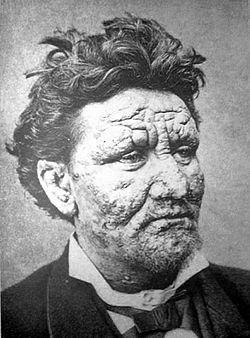
- (pathology) Of a facies (“a person's facial features”): resembling those of a lion as a result of some disease, especially a form of leprosy which causes leontiasis (“a medical condition characterized by an overgrowth of the cranial and facial bones”); also, of leprosy: causing a lionlike facies.
-
leonine facies
-
1883, James Nevins Hyde, “Neoplastic”, in A Practical Treatise on Diseases of the Skin, […], Philadelphia, Pa.: Henry C[harles] Lea’s Son & Co., →OCLC, class IX (Of the Skin with Involvement of Other Organs), page 431:
-
From syphilis, which is also a disease whose lesions are polymorphic in character, lepra can be distinguished by […] the characteristic leonine facies of its tubercular forms.
-
-
1890 November, “Leprosy in Louisiana—Necessity of Providing for Lepers”, in New Orleans Medical and Surgical Journal, volume XVIII (New Series), number 5, New Orleans, La.: L. Graham & Son, […], →OCLC, page 396:
-
A careful examination showed that the man was suffering from leprosy in an advanced stage; his face had the leonine expression, and the husky voice doubtless indicated that the disease had invaded the larynx.
-
-
2000, Elinor Lieber, “Old Testament ‘Leprosy’, Contagion and Sin”, in Lawrence I[rvin] Conrad, Dominik Wujastyk, editors, Contagion: Perspectives from Pre-modern Societies, Aldershot, Hampshire: Ashgate Publishing, published 2017, →ISBN, part III (Middle East and Europe), page 129:
-
-
派生語
- leoninely
- leonine share
- leoninity
語源 2
The adjective is derived from Late 中期英語 leonin, leonine (“of or pertaining to a person named Leo; specifically Pope Leo IV”), from Latin leōnīnus, from Leo (“man’s name”) (from leo (“lion”): see etymology 1) + -īnus (suffix meaning ‘of or pertaining to’).
Sense 2 (“being or relating to a kind of verse with internal rhyme”) is said to refer to a (possibly apocryphal) medieval monk named Leo or Leonius who composed verse with this characteristic; his identity is uncertain, but the composer Léonin (also known as Leo, Leoninus, or Leonius; flourished 1135–1201) has been suggested. Alternatively, the word may refer to Pope Leo II (c. 611–683): see the c. 1760–1761 quotation.
The noun is derived from the adjective.
形容詞
leonine (not comparable)
- Of or pertaining to one of the popes named Leo; specifically (in Leonine City), to Pope Leo IV (r. 847–855) who ordered the building of a wall around Vatican Hill to protect what is now Vatican City, or (in Leonine Prayers) to Pope Leo XIII (r. 1878–1903).
- (poetry) Being or relating to a kind of medieval Latin verse, generally alternative hexameter and pentameter, with rhyming at the middle and end of a line (that is, internal rhyme); also (by extension), of or relating to modern verse having internal rhyme.
-
leonine rhyme
-
1712, [Bernard de] Montfaucon, “My Journey to Siena; […]”, in [John Henley?], transl., The Travels of the Learned Father Montfaucon from Paris thro’ Italy. […], London: […] D. L. for E[dmund] Curll […], E[gbert] Sanger […], R[obert] Gosling […], and W. Lewis […], →OCLC, page 403:
-
In the Church of St. Dominick is a ſmall Picture of the Bleſſed Virgin, vvith the Infant JESUS in her Arms, vvell painted, and yet, appears to have been done in the Iron Age of Painting and other Arts, by the follovving verses, vvrit under it. […] Theſe Leonine Verſes, as plainly appears by them, expreſs a Senſe contrary to the Intention of the VVriter.
-
-
c. 1760–1761 (date written; published 1814), Thomas Gray, “[Essays. Metrum.] Observations on the Pseudo-Rhythmus.”, in Edmund Gosse, editor, The Works of Thomas Gray in Prose and Verse. […], volume I (Poems, Journals, and Essays), London: Macmillan and Co., published 1884, →OCLC, pages 374–375:
-
Observe, that, if the date of this poem be true, the general opinion, that the Leonine verse owes its name to Leonius, seems to be false; […] It is not therefore very likely, as Leonius flourished in 1154, that he should give name to such Latin verses upwards of thirty years before. Indeed some people have thought that it was called after Leo, probably the Second, who lived in 684, a pope who is said to have reformed the hymns and the music of the church.
-
-
1837–1839, Henry Hallam, “On the General State of Literature in the Middle Ages to the End of the Fourteenth Century”, in Introduction to the Literature of Europe, in the Fifteenth, Sixteenth and Seventeenth Centuries, volume I, London: John Murray, […], →OCLC, paragraph 84, page 100:
-
別の表記
- Leonine
名詞
leonine (plural leonines)
- (poetry, chiefly in the plural) Synonym of Leonine verse (“a kind of medieval Latin verse, generally alternative hexameter and pentameter, with rhyming at the middle and end of a line (that is, internal rhyme)”).
-
1715, “Canto III”, in The Miller of Trompington: being an Exercise upon Chaucer’s Reeve’s Tale, London: […] Jonas Brown, […]; and sold by J[ames] Roberts […], →OCLC, pages 44–45:
-
A[llen]. The Clink of Syllables call'd Rymes, / Brought in ith' barb'rous Runick times, / To ſober Criticks ſeems to be / A paultry part of Poetry, / Becoming Monkiſh dull Divines, / VVho traded much in Leonines. / J[ohn]. Altho' to ſpoil I ſhould be ſorry, / An undergraduate Antiquary, / Yet I'll produce a Line or tvvo / Of Leonines in Cicero, / Before the Monks long time ago.
-
-
1771 December, “Illustration of the Inscription on Sir W[illiam] Browne’s Monument. […] Continued from Our Last. The Notes.”, in The Town and Country Magazine; or, Universal Repository of Knowledge, Instruction, and Entertainment, volume III, London: […] A[rchibald] Hamilton Junr. […]; [a]nd sold by Robinson and Roberts, […], →OCLC, page 648, column 1:
-
1835 March, “Art. V.— […] 4. Collection of English Proverbs of the Twelfth Century, Translated into Latin Leonines. MS. Trin. Coll. Camb. O. 2. 45. (Unpublished.) [book review]”, in Cochrane’s Foreign Quarterly Review, volume I, number II, London: Whittaker & Co. […]; Edinburgh: Robert Cadell, […], →OCLC, page 395:
-
The manuscript of Trinity College, Cambridge, which we have already mentioned, was written at the beginning of the thirteenth century, and the proverbs which it contains are translations into Latin leonines of some of the more popular English, and, in one or two instances, Norman proverbs of that time.
-
-
派生語
- Leonine verse
語源 3
Learned borrowing from Medieval Latin leōnīna + English -ine (suffix meaning ‘of or pertaining to’). Leōnīna is a feminine singular form of Latin leōnīnus (see etymology 1), and may refer to the use of a lion motif on the coin: see the 1787 quotation.
名詞
leonine (plural leonines)
- (numismatics, historical) A 13th-century coin minted in Europe and used in England as a debased form of the sterling silver penny; it was outlawed under Edward I (reigned 1272–1307).
-
1577, Raphaell Holinshed, “Edward the Fyrste”, in The Laste Volume of the Chronicles of England, Scotlande, and Irelande […], volume II, London: […] for Iohn Hunne, →OCLC, page 835, column 2:
-
In the eyghte and twentye yere of his raign in the Chriſtmaſſe ſeaſon Kyng Edwarde ſet foorth a proclamation, forbidding and prohibiting all foraine coine to bee receyued and payde as ſterling mony wythin his dominion, commaunding by the ſame proclamation, that two peeces of them ſhould go for one ſterlying, vntill the feaſt of Eaſtre. There were diuers moneyes in thoſe dayes currant wythin this realme, as Pollardes, Crocards, Staldinges, Egles, Leonines, Steepinges, and all theſe were white monyes, artificially made of ſiluer, copper, and ſulphur, ſo that it was an yll tyme for baſe moneyes, and muche choppyng and chaunging was vſed in buying and ſelling of thynges.
-
-
1642, Edw[ard] Coke, “Stat. de Tallagio non Concedendo, Edit. Anno 34 Edw. I.”, in The Second Part of the Institutes of the Laws of England. […], London: […] M[iles] Flesher, and R[obert] Young, for E[phraim] D[awson], R[ichard] M[eighen], W[illiam] L[ee] and D[aniel] P[akeman], →OCLC, chapter XX, page 577:
-
[I]n the raign of E[dward] I. there were divers white monies called Pollards, Crocards, Staldings, Eagles, Leonines, and Steepings artificially made of ſilver, copper, and ſulphur, and yet currant within the Realme; and for that two pieces of theſe monies were but of the value of one ſterling. King E. I. by his Proclamation utterly forbad the ſame.
-
-
1787, John Topham, “Observations on the Wardrobe Account of the 28th Year of King Edward the First”, in Liber quotidianus contrarotulatoris garderobae. Anno regni regis Edwardi primi vicesimo octavo. A.D. MCCXCIX. & MCCC. […] [Daily Book of the Counter-roll of the Wardrobe. In the Twenty-eighth Year of the Reign of King Edward the First. A.D. 1299 & 1300. […]], London: […] J[ohn] Nichols […], →OCLC, page xxii:
-
[M]oſt deceits and corruptions are found in this reign [of Edward I of England], vvhen there vvas imported (beſides clipped ſterlings) a ſort of light money vvith a mitre, another with a lion, a third of copper blanched in imitation of the Engliſh money, a fourth like that of King Edvvard, and a fifth kind that vvas plated, and others, knovvn by the name of Pollards, Crokards, Mitres, Lionines, Staldings, Steepings, Eagles and Roſarys, vvhich vvere coined in parts beyond the ſeas, and privately brought into the kingdom, and uttered here for ſterling, though not vvorth above an halfpenny.
-
-
別の表記
- Leonine
- lionine (obsolete)
参照
- ↑ “leonīn(e, adj.”, in MED Online, Ann Arbor, Mich.: University of Michigan, 2007.
- ^ “leonine, adj.”, in OED Online
 , Oxford: Oxford University Press, September 2023; “leonine, adj.”, in Lexico, Dictionary.com; Oxford University Press, 2019–2022.
 - ↑ “leonine, adj. and n.”, in OED Online , Oxford: Oxford University Press, July 2023; “Leonine, adj.”, in Lexico, Dictionary.com; Oxford University Press, 2019–2022.
- ^ “† Leonine, n.”, in OED Online , Oxford: Oxford University Press, September 2023.

Further reading

アナグラム
- Noeline, neoline



- Copyright (c) 1995-2026 Kenkyusha Co., Ltd. All rights reserved.

- Copyright © Benesse Holdings, Inc. All rights reserved.

- © 2000 - 2026 Hyper Dictionary, All rights reserved

- 日本語ワードネット1.1版 (C) 情報通信研究機構, 2009-2010 License All rights reserved.
WordNet 3.0 Copyright 2006 by Princeton University. All rights reserved. License
- Wiktionary
- Text is available under Creative Commons Attribution-ShareAlike (CC-BY-SA) and/or GNU Free Documentation License (GFDL).
Weblio英和・和英辞典に掲載されている「Wiktionary英語版」の記事は、Wiktionaryのleonine (改訂履歴)の記事を複製、再配布したものにあたり、Creative Commons Attribution-ShareAlike (CC-BY-SA)もしくはGNU Free Documentation Licenseというライセンスの下で提供されています。
- CMUdict
- CMUdict is Copyright (C) 1993-2008 by Carnegie Mellon University.
