

![[N16-A12A]](https://cdn.weblio.jp/e7/wbr/CHUJITEN/N16-A12A_F-000000_B-FFFFFF.png) ]
] 調べた例文を記録して、効率よく覚えましょう
Weblio会員無料で登録できます
 履歴機能
過去に調べた単語を確認できる
履歴機能
過去に調べた単語を確認できる
 語彙力診断
診断回数が4回に増加
語彙力診断
診断回数が4回に増加
 マイ単語帳
便利な学習機能付き
マイ単語帳
便利な学習機能付き
 マイ例文帳
文章で意味を理解できる
マイ例文帳
文章で意味を理解できる
日本語WordNet(英和)

maenad
名詞

Wiktionary英語版
出典:Wiktionary
maenad
出典:『Wiktionary』 (2026/04/05 22:05 UTC 版)
語源
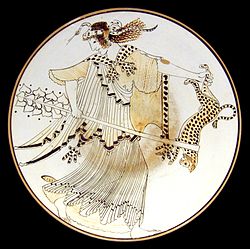

From Latin Maenad- (“frenzied female follower of Bacchus”), root of Maenās, from Ancient Greek μαινάς (mainás, “raving, frantic”), from μαίνομαι (maínomai, “to be mad, to rage”), ultimately from Proto-Indo-European *men- (“to mind; to think; spiritual activity”).
発音
- (Received Pronunciation) IPA: /ˈmiːnæd/, /ˈmaɪ-/
- (General American) IPA: /ˈmiˌnæd/, /ˈmaɪ-/
- ハイフネーション: maen‧ad
名詞
maenad (plural maenads or maenades)
- (Greek mythology, also attributive) A female follower of Dionysus (“the god of wine”), associated with intense revelling.
- Synonyms: Baccha, bacchante, Bassarid
- Coordinate term: bacchant
-
1818–1819 (date written), Percy Bysshe Shelley, “Prometheus Unbound”, in Prometheus Unbound […], London: C[harles] and J[ames] Ollier […], published 1820, →OCLC, Act IV, scene i, pages 146–147:
-
1914, Charles Waldstein, “The Subject-matter of Art”, in Greek Sculpture and Modern Art: Two Lectures Delivered to the Students of the Royal Academy of London, Cambridge, Cambridgeshire: [Cambridge] University Press, →OCLC, page 53:
- (by extension, literary, derogatory) An excessively emotional or wild woman.
-
1919, W[illiam] Somerset Maugham, chapter XXX, in The Moon and Sixpence, [New York, N.Y.]: Grosset & Dunlap Publishers […], →OCLC, page 162:
-
Blanche Stroeve was in the cruel grip of appetite. Perhaps she hated Strickland still, but she hungered for him, and everything that had made up her life till then became of no account. She ceased to be a woman, complex, kind and petulant, considerate and thoughtless; she was a Maenad. She was desire.
-
-
派生語
- maenadic
- maenadism
Notes
- ^ From the collection of the Staatliche Antikensammlungen (State Collections of Antiquities) in Munich, Bavaria, Germany.
- ^ From the collection of the Römisch-Germanisches Museum (Romano-Germanic Museum) in Cologne, North Rhine-Westphalia, Germany.
参照
- “maenad”, in OED Online
 , Oxford: Oxford University Press, launched 2000.
 - “maenad”, in Merriam-Webster.com Online Dictionary, Springfield, Mass.: Merriam-Webster, 1996–present.
- Douglas Harper (2001–2026), “maenad”, in Online Etymology Dictionary.
- “maenad”, in The American Heritage Dictionary of the English Language, 5th edition, Boston, Mass.: Houghton Mifflin Harcourt, 2016, →ISBN.


アナグラム
ウィキペディア英語版
出典:Wikipedia
Maenad
出典:『Wikipedia』 (2011/04/27 13:37 UTC 版)
英語による解説
ウィキペディア英語版からの引用
- 引用
In Greek mythology, maenads (Ancient Greek: μαινάδες, mainádes) were the female followers of Dionysus (Bacchus in the Roman pantheon), the most significant members of the Thiasus, the god's retinue. Their name literally translates as "raving ones". Often the maenads were portrayed as inspired by him into a state of ecstatic frenzy, through a combination of dancing and drunken intoxication. In this state, they would lose all self-control, begin shouting excitedly, engage in uncontrolled sexual behavior, and ritualistically hunt down and tear to pieces animals — and, in myth at least, sometimes men and children — devouring the raw flesh. During these rites, the maenads would dress in fawn skins and carry a thyrsus, a long stick wrapped in ivy or vine leaves and tipped by a cluster of leaves; they would weave ivy-wreaths around their heads, and often handle or wear snakes. German philologist Walter Friedrich Otto writes that
名詞の変化形:
|



- Copyright (c) 1995-2026 Kenkyusha Co., Ltd. All rights reserved.

- © 2000 - 2026 Hyper Dictionary, All rights reserved
- 日本語ワードネット1.1版 (C) 情報通信研究機構, 2009-2010 License All rights reserved.
WordNet 3.0 Copyright 2006 by Princeton University. All rights reserved. License
- Wiktionary
- Text is available under Creative Commons Attribution-ShareAlike (CC-BY-SA) and/or GNU Free Documentation License (GFDL).
Weblio英和・和英辞典に掲載されている「Wiktionary英語版」の記事は、Wiktionaryのmaenad (改訂履歴)の記事を複製、再配布したものにあたり、Creative Commons Attribution-ShareAlike (CC-BY-SA)もしくはGNU Free Documentation Licenseというライセンスの下で提供されています。
- Wikipedia
- Text is available under Creative Commons Attribution-ShareAlike (CC-BY-SA) and/or GNU Free Documentation License (GFDL).
Weblio英和・和英辞典に掲載されている「Wikipedia英語版」の記事は、WikipediaのMaenad (改訂履歴)の記事を複製、再配布したものにあたり、Creative Commons Attribution-ShareAlike (CC-BY-SA)もしくはGNU Free Documentation Licenseというライセンスの下で提供されています。
- CMUdict
- CMUdict is Copyright (C) 1993-2008 by Carnegie Mellon University.
