

調べた例文を記録して、効率よく覚えましょう
Weblio会員無料で登録できます
 履歴機能
過去に調べた単語を確認できる
履歴機能
過去に調べた単語を確認できる
 語彙力診断
診断回数が4回に増加
語彙力診断
診断回数が4回に増加
 マイ単語帳
便利な学習機能付き
マイ単語帳
便利な学習機能付き
 マイ例文帳
文章で意味を理解できる
マイ例文帳
文章で意味を理解できる
Wiktionary英語版
出典:Wiktionary
maniple
出典:『Wiktionary』 (2024/08/14 21:47 UTC 版)
WOTD – 6 September 2020
発音

- (Received Pronunciation) IPA: /ˈmænɪp(ə)l/
- (General American) IPA: /ˈmænəpəl/
- ハイフネーション: man‧i‧ple
語源 1
From Late 中期英語 maniple, manyple (“scarf worn as vestment, maniple”), borrowed from Middle French, Old French maniple, manipule (“handful; troop of soldiers; scarf worn as vestment”) (modern French manipule), from Latin manipulus (“bundle, handful; troop of soldiers”), from manus (“hand”) (ultimately from Proto-Indo-European *(s)meh₂- (“to beckon, signal”)) + the weakened root of pleō (“to fill; to fulfil”) (ultimately from Proto-Indo-European *pleh₁- (“to fill”)). The English word is cognate with Italian manipulo (“scarf worn as vestment”) (obsolete), manipolo (“handful; troop of soldiers; scarf worn as vestment”).
Sense 2 (“part of a priest’s vestments”) is probably from the fact that the item was originally carried in the hand. It may originate from a handkerchief or napkin worn by Roman consuls as an indication of rank.
名詞
- (Ancient Rome, military) A division of the Roman army numbering 120 (or sometimes 60) soldiers exclusive of officers; (generally, obsolete) any small body of soldiers.
-
1655, Clement Edmond[e]s, “The Second Commentary of the Wars in Gallia. [Observation.]”, in Julius Caesar, translated by Clement Edmond[e]s, The Commentaries of C. Julius Cæsar, of His Warres in Gallia, and the Civile Warres betwixt Him and Pompey, Translated into English: […], revised edition, London: […] R[oger] Daniel; and are to be sold by Henry Tvvyford, […], Nathaniel Ekins […], and Iohn Place […], →OCLC, book II, page 43:
-
[T]hey divided the Haſtati, Principes, and Triaris, each of them into 10 companies, making of thoſe three ſorts of ſouldiers 30 ſmall regiments, which they called Manipuli: And again, they ſubdivided each maniple into two equall parts, and called them Ordines, which was the leaſt company in a legion, and according to the rate ſet down by Polybius, contained 60 ſouldiers. […] By this therefore it may appear that a legion conſiſted of four ſorts of ſouldiers, which were reduced into ten cohorts, and every cohort contained three maniples, and every maniple two orders, and every order had his Centurion marching in the head of the troop, and every Centurion had his Optionem, or Lieutenant, that ſtood in the tail of the troop.
-
-
1709, Caius Crispus Sallustius [i.e., Gaius Sallustius Crispus], “The History of Caius Crispus Sallustius: Containing an Account of the Jurgurthine War”, in John Rowe, transl., Caius Crispus Sallustius the Historian Made English. […], London: […] Richard Sare, […], →OCLC, page 126:
-
And preſently changing the Order of his March, made his Flank which was next the Enemy thrice as ſtrong as it was before; plac'd ſeveral Spearmen and Slingers between the Battalions or Maniples of foot; planted all the Cavalry in the Wings; And after a brief Excitation to his Soldiers, caus'd the Army in this Figure to file off to the Left, and towards the Plain.
-
-
1833 June, “Art. II.—Documents Communicated to Congress by the President, at the Opening of the Second Session of the Twenty-second Congress, Accompanying the Report of the Secretary of War.”, in American Quarterly Review, volume XIII, number XXVI, Philadelphia, Pa.: [Henry Charles] Carey, [Isaac] Lea & Blanchard […], →OCLC, page 298:
-
Our Army, besides being of an insignificant strength compared with the physical force of the country, and so detached and scattered as to be mere maniples of men, has been so frequently into its original elements of citizenship, and has at all times so mingled with our social institutions, as to appear a homogeneous part of the grand community, and only a better regulated and more effective body of militia.
-
-
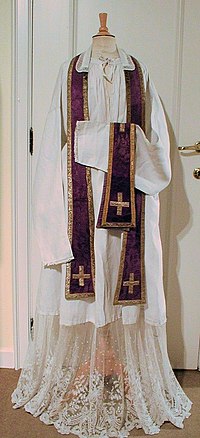
- (Christianity, chiefly historical) In Western Christianity, an ornamental band or scarf worn upon the left arm as a part of the vestments of a priest in the Roman Catholic Church, and sometimes the Church of England.
-
1590, Edward Deering [i.e., Edward Dering], “The Three and Twentie Lecture, vpon the 4. 5. and 6. Verses”, in XXVII. Lectvres, or Readings, vpon Part of the Epistle Written to the Hebrues, London: […] Thomas VVoodcocke, →OCLC:
-
[T]hey, as men thinking baſelie of ſuch ſimple dealing, adde a great deale more to making of their prieſts: they muſt haue oyle, candels, baſens, tovvels, amices, albes, ſtoals, gyrdles, maniples, miters, bookes, croſſes, linnen, bandes, chalices, patens, ſinging cakes, vvine and vvater, flovver, and ſuch other thinges, trifled and toyed with all, […]
-
-
1685, William Howel, “Sect. XII. The Monarchy of the English Saxons Restored in Britain. […]”, in An Institution of General History, or The History of the Ecclesiastical Affairs of the World. […], London: […] [F]or the authors widdow, by Miles Flesher, →OCLC, paragraph 156, page 332:
-
[T]hen ſhall the Juſtice of the Biſhop (his Officer he means) cauſe a Proceſſion to be made with a Prieſt, habited in an Albe Maniple, and Stole, and Clerks in their Surplices, with Holy-water and a Croſs, the Candleſticks and Incense-pot, with Fire and Incenſe going before, and the Friends of the dead having taken his Body up, ſhall put it on a Biere, and carry it to the Church, where Maſs being ſaid for him, and other Rites performed, they ſhall Inter him as becomes a Chriſtian.
-
-
1812, James Bentham, James Bentham [Jr.], “Abbots of Ely”, in The History and Antiquities of the Conventual & Cathedral Church of Ely: […], 2nd edition, Norwich, Norfolk: […] Stevenson, Matchett, and Stevenson, […], →OCLC, page 91:
-
On inspecting the Body [of Leofric, Abbot IV], they found it quite decayed; but the clothing, particularly the Cassock and Archiepiscopal Pall affixed to it with gilded pins, and the Stole and Maniple, so entire; that it was a matter of wonder to them, how they could have laid so long in that state, and yet continue so perfect as they found them.
-
-
1829, [John Chambers [et al.]], “City or Norwich”, in A General History of the County of Norfolk, […], volume II, Norwich, Norfolk: […] John Stacy; London: […] Longman, Rees, Orme, Brown, and Green, →OCLC, page 1041:
-
The effigy of this bishop [James Goldwell, Bishop of Norwich] is distinguished by the richness of his vestments, these are the cope, with a rich border of lace, closed on the breast, with a large square morse or fibula; beneath the cope is the dalmatic, alb, stole, &c. as usual, and hanging from the left arm is the maniple.
-
-
1923, Compton Mackenzie, “The Mission to the Hoppers”, in The Parson’s Progress, London, New York, N.Y.: Cassell and Company, →OCLC, pages 77–78:
-
"Can't say Mass this morning. Can't say Mass. I've forgotten to bring the maniple. No maniple. No Mass. It's that muddle-headed Mrs. Gladstone. I told her to be sure she packed all my vestments. And she's forgotten the maniple." […] Mark knew that Dorward was not serious in refusing to say Mass, and after a short argument it was agreed that the absence of a maniple would not invalidate the Mass.
-
-
- (obsolete, informal) A hand; a fist.
-
1833 December, “The Poets of the Day. Batch the Third.”, in Fraser’s Magazine for Town and Country, volume VIII, number XLVIII, London: James Fraser […], →OCLC, page 658, column 2:
-
His poem, however, is meetly enough entituled—Christ Crucified! But the Rev. William Ellis Wall is worse than [Pontius] Pilate. That "wretch," as this miserable calls the Roman governor, was careful to wash his hands of all guilt in the transaction; but the Rev. William Ellis Wall holds forth triumphantly his two unhallowed and incarnadine maniples of reeking digits, boasting of the infamous achievement in a most egregious preface.
-
-
別の表記
参考
- (part of a priest's vestments): epimanikion
語源 2
Probably from Late Latin manipulus (“bundle, handful; drachm”) (see further at etymology 1), modelled on Ancient Greek δράγμα (drágma, “bundle, handful; sheaf”) which was confused with δραχμή (drakhmḗ, “drachm”).
名詞
- (obsolete) A handful.
参照
- ^ “maniple, n.”, in MED Online, Ann Arbor, Mich.: University of Michigan, 2007.
- ↑ “maniple, n.”, in OED Online
 , Oxford, Oxfordshire: Oxford University Press, September 2000.
 - ^ “maniple, n.”, in Lexico, Dictionary.com; Oxford University Press, 2019–2022.

Further reading

アナグラム
- impanel, palmine



- © 2000 - 2026 Hyper Dictionary, All rights reserved
- Wiktionary
- Text is available under Creative Commons Attribution-ShareAlike (CC-BY-SA) and/or GNU Free Documentation License (GFDL).
Weblio英和・和英辞典に掲載されている「Wiktionary英語版」の記事は、Wiktionaryのmaniple (改訂履歴)の記事を複製、再配布したものにあたり、Creative Commons Attribution-ShareAlike (CC-BY-SA)もしくはGNU Free Documentation Licenseというライセンスの下で提供されています。
- CMUdict
- CMUdict is Copyright (C) 1993-2008 by Carnegie Mellon University.
