


| 意味 |
spring forward, fall backとは 意味・読み方・使い方
追加できません
(登録数上限)
 単語を追加
単語を追加
Wiktionary英語版での「spring forward, fall back」の意味 |
spring forward, fall back
出典:『Wiktionary』 (2025/09/09 13:51 UTC 版)
語源
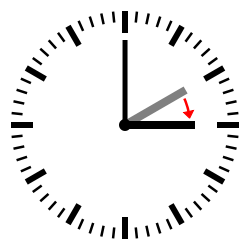

When daylight saving time (DST) begins chronometers are put forward (usually by an hour), and then turned back by the same amount of time when DST ends.
A pun on spring (“(noun) season of the year in temperate regions in which plants spring from the ground and into bloom and dormant animals spring to life; (verb) to move or burst forth”) and US English fall (“(noun) season of the year in temperate regions when the leaves typically fall from the trees; (verb) to move to a lower position under the effect of gravity”).
発音
- (Received Pronunciation) IPA: /ˌspɹɪŋ ˈfɔːwəd ˌfɔːl ˈbæk/
- (General American) IPA: /ˌspɹɪŋ ˈfɔɹwəɹd ˌfɔl ˈbæk/
- 韻: -æk
- ハイフネーション: spring for‧ward, fall back
成句
spring forward, fall back
- (mnemonic) Used to recall how timepieces are adjusted for daylight saving time: Local time goes forward in the spring (usually by one hour), and back in fall (autumn).
-
1971 October 28, Craig Hosmer, “Fiddling around with ‘God’s Time’”, in Congressional Record: Proceedings and Debates of the 92d Congress, First Session (United States House of Representatives), volume 117, part 29, Washington, D.C.: United States Government Printing Office, →ISSN, →OCLC, page 38086, column 3:
-
[I]f we have to standardize on one time period, it would seem eminently logical to settle on daylight time for the convenience of the greatest number of people. Besides, under such a system, we would once and for all abolish the trivial "Spring forward, fall back."
-
-
1976 June 9, Keith G[eorge] Sebelius, “Statement of Hon. Keith G. Sebelius, a Representative in Congress from the State of Kansas”, in Daylight Savings Time Act of 1976: Hearings before the Subcommittee on Transportation and Commerce of the [Committee] on Interstate and Foreign Commerce, House of Representatives, Ninety-fourth Congress, Second Session on H.R. 13089, H.R. 13090 (and All Similar Bills), Bills to Amend the Uniform Time Act of 1966 to Change the Period of Observance of Daylight Savings Time: And S. 2931, a Bill to Provide for Daylight Saving Time on a Seven-month Basis, and to Require the Federal Communications Commission to Permit Certain Daytime Broadcast Stations to Operate before Local Sunrise […] (Serial No. 94-109), Washington, D.C.: U.S. Government Printing Office, →OCLC, page 80:
-
I think it is important to remember the great push for year-round daylight saving time came as a result of the energy crisis of 1973. It was alleged this action would result in home heating, gasoline, and electricity savings and as a result the Congress got into the spring-forward, fall-back business of daylight saving time. Today, some 3 years later, we find no evidence of energy savings in the home, no effect on gasoline consumption, and that savings on electricity are not conclusive.
-
-
1981 April, Philip R. Smith, “Daylight Saving? Well, It’s about … Time”, in Denise M. Gower, editor, DFSC Chronicle, Alexandria, Va.: Defense Fuel Supply Center, Defense Supply Agency, United States Department of Defense, →OCLC, page 27:
-
The first Federal legislation on the matter was enacted during World War I with the passage of the Standard Time Act on March 19, 1918. […] To conserve fuel and aid the war effort, the act also provided that the standard time of each zone would be advanced one hour for seven months of the year, beginning in early spring and ending in the fall. Thus developed the slogan still used today: "Spring forward; fall back."
-
-
2002, John B. Arden, “Tricking Yourself into Remembering”, in Improving Your Memory for Dummies (For Dummies), Hoboken, N.J.: Wiley Publishing, →ISBN, part III (Preserving Your Memory):
-
Twice a year, in April and October, most people change their clocks by one hour. Almost everyone forgets if the time needs to move forward or move backward. If you use the simple mnemonic, "Spring forward, fall back," you won't have to find out the hard way that you forgot to change your clock. This timely mnemonic links the season with the action of the same time: In the spring, the time springs forward by an hour. In the fall, time falls back by an hour.
-
-
2004, Sue Townsend, “Saturday March 29th [2003]”, in Adrian Mole and the Weapons of Mass Destruction, London: Michael Joseph, →ISBN, page 324:
-
I asked to speak to my mother again, and said, ‘Is it tonight we have to change the clocks?’ / She said that it was. / I asked if it was forwards or backwards; I can never remember which. / She said, ‘It’s easy: spring forward, fall back.’ / I said, ‘But do the clocks go backwards or forwards?’ / She said again, ‘Spring forward, fall back.’
-
-
2023, Eklas Hossain, “Energy without the Sun”, in The Sun, Energy, and Climate Change, Cham, Zug, Switzerland: Springer Nature, , →ISBN, page 215:
-
This practice of taking the clock time forward during spring and backward during fall is known as daylight saving (DST). It is also implied by the popular notion Spring Forward, Fall Back, referring to the advancement of the clock during spring and the going back in time in fall. […] Since 2007, in the USA, the DST starts on the 2nd Sunday of March. On that day, the clocks are moved one hour forward at 2 a.m. local standard time. This means that 2 a.m., the clocks are manipulated to read 3 a.m. local daylight time. Again, DST ends on the 1st Sunday of November, when clocks are moved backward by one hour at 2 a.m. local daylight time. So, at 2 a.m., the clocks are changed to read 1 a.m. local standard time.
-
-
Further reading
 daylight saving time on Wikipedia.Wikipedia

|

| 意味 |
|
|
spring forward, fall backのページの著作権
|
Text is available under Creative Commons Attribution-ShareAlike (CC-BY-SA) and/or GNU Free Documentation License (GFDL). Weblio英和・和英辞典に掲載されている「Wiktionary英語版」の記事は、Wiktionaryのspring forward, fall back (改訂履歴)の記事を複製、再配布したものにあたり、Creative Commons Attribution-ShareAlike (CC-BY-SA)もしくはGNU Free Documentation Licenseというライセンスの下で提供されています。 |
ピン留めアイコンをクリックすると単語とその意味を画面の右側に残しておくことができます。 |
こんにちは ゲスト さん

ログイン |
Weblio会員(無料)になると

|
 検索履歴を保存できる!
※モジュールの非表示は、から変更可能
 みんなの検索ランキング
 閲覧履歴
閲覧履歴


 | 「spring forward, fall back」のお隣キーワード |
weblioの他の辞書でも検索してみる
weblioのその他のサービス
weblioのその他のサービス
こんにちは ゲスト さん
|
ログイン |
Weblio会員(無料)になると
|
