

研究社 新英和中辞典

wide
wide /wάɪd/

1 a 幅の広い,幅広の (⇔narrow) 《★【比較】 broad とほぼ同義だが,wide は端から端までの距離に重きを置き,broad は広がりに重きを置く》.
b [数量を示す語句を伴って] 幅が…の (cf. long1 1d).
2 a (面積が)広い,広大な,広々とした 《★【比較】 部屋などが「広い」という時は large や big を用いる》.
b (範囲の)広い,広汎な,多方面の.
3 〈目・窓など〉大きく開いた[広げた].
4 a 自由な,拘束されない; 偏狭でない,偏見のない; 大まかな.
b ゆるやかな,たっぷりした.
5 〈知識など〉(範囲の)広い.
6 a かけ離れた.
b 叙述的用法の形容詞 〔+of+(代)名〕〔的などから〕遠く離れて,見当違いで.
c 【クリケット】 遠くはずれた.
7 《英俗》 ずるい,悪賢い.
1 広く,広範囲に.
2 大きく開いて,十分にあけて.
3 的をそれて,見当はずれに.
形容詞
- 用例
-
- 用例
-
- a wide difference 大きな相違.
副詞
名詞可算名詞
【語源】
‐wide
調べた例文を記録して、効率よく覚えましょう
Weblio会員無料で登録できます
 履歴機能
過去に調べた単語を確認できる
履歴機能
過去に調べた単語を確認できる
 語彙力診断
診断回数が4回に増加
語彙力診断
診断回数が4回に増加
 マイ単語帳
便利な学習機能付き
マイ単語帳
便利な学習機能付き
 マイ例文帳
文章で意味を理解できる
マイ例文帳
文章で意味を理解できる
Eゲイト英和辞典

wide
音節wide発音記号・読み方wáɪd変化wid・er; wid・est
覚え方両端のあいだの開きが大きい,幅がある
形容詞
副詞
覚え方両端のあいだの開きが大きい,幅がある
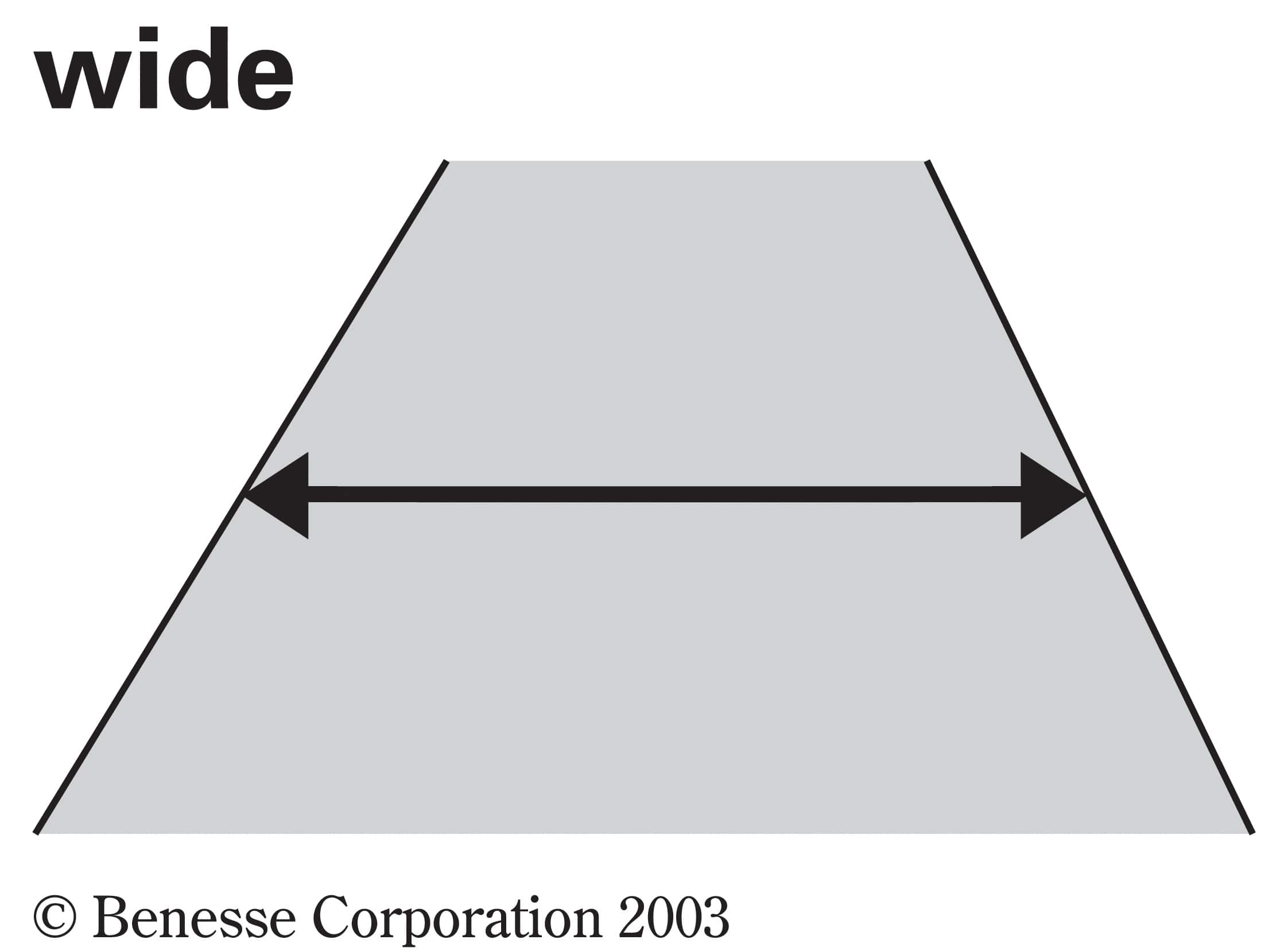 |
形容詞
1a幅が広い,幅がある(←→narrow)
b幅が…の,…の幅で(←→long)(長さを表す語句かhowの後ろで用いる)(w.と略す)
2(種類・関心・経験などの範囲が)幅広い,広い
3(戸・目などが)大きく開いた
4(格差・隔たりが)大きい;〈的・目標などから〉大きく外れた,かけ離れた〈of〉
5≪音声≫開口音の
b幅が…の,…の幅で(←→long)(長さを表す語句かhowの後ろで用いる)(w.と略す)
2(種類・関心・経験などの範囲が)幅広い,広い
3(戸・目などが)大きく開いた
4(格差・隔たりが)大きい;〈的・目標などから〉大きく外れた,かけ離れた〈of〉
5≪音声≫開口音の
副詞
ネットワークwideとbroad wideが「両端の間の開き[幅]が大きい」という意であるのに対し,broadは「さえぎるものがなく,広々とした」という意.wideを(横向きの)線の長さ(⇒コア図),broadを(扇のような)面の広がりとしてイメージすると違いを理解しやすい.「大きな隔たり」をa wide gapというのは,2つのものの間の隔たりを指すから.また,「広い意味では」をin a broad senseというのは,「意味の広がり」が横幅ではなく,扇のような広がりをイメージするため |
コンピューター用語辞典

wide
WIDE
WIDE<Widedy Integrated Distributed Environment>
WIDE<Widedy Integrated Distributed Environment>
日本語WordNet(英和)

wide
副詞
形容詞
- 用例
Weblio英和対訳辞書

Wiktionary英語版
出典:Wiktionary
wide
出典:『Wiktionary』 (2026/05/21 20:28 UTC 版)
語源
From 中期英語 wid, wyd, from 古期英語 wīd (“wide, vast, broad, long; distant, far”), from Proto-Germanic *wīdaz, from Proto-Indo-European *h₁weydʰh₁- (“to divide, separate”), a dissimilated univerbation from *dwi- (“apart, asunder, in two”) + *dʰeh₁- (“to do, put, place”).
発音
- (Received Pronunciation, General American) IPA: /waɪd/
- (General Australian, New Zealand) IPA: /wɑed/
- 韻: -aɪd
形容詞
wide (comparative wider or more wide, superlative widest or most wide)
- Having a large physical extent from side to side.
-
1993, Jacqueline Mitton, The Penguin Dictionary of Astronomy, 2nd edition (paperback), Penguin Books, →ISBN, page 127:
-
Over a wider region either side of the path of totality, a partial eclipse is seen.
-
- Large in scope.
-
The inquiry had a wide remit.
-
2013 July-August, Fenella Saunders, “Tiny Lenses See the Big Picture”, in American Scientist, archived from the original on 5 September 2015:
-
2023 May 29, Madeline Holcombe, “Lizzo is teaching us about body neutrality. Here is what it means and how to get there”, in CNN:
-
Lizzo, who is known for messages of self-love and wider acceptance, has recently said as much as she shared that she is encouraging a stance of body neutrality for herself and others.
-
-
- (slang, derogatory, humorous) Overweight, obese.
- (sports) Operating at the side of the playing area.
- On one side or the other of the mark; too far sideways from the mark, the wicket, the batsman, etc.
-
1596 (date written; published 1633), Edmund Spenser, A Vewe of the Present State of Irelande […], Dublin: […] Societie of Stationers, […], →OCLC; republished as A View of the State of Ireland […] (Ancient Irish Histories), Dublin: […] Society of Stationers, […] Hibernia Press, […] [b]y John Morrison, 1809, →OCLC:
- (phonetics, dated) Made, as a vowel, with a less tense, and more open and relaxed, condition of the organs in the mouth.
- (Scotland, Northern England, now rare) Vast, great in extent, extensive.
-
The wide, lifeless expanse.
-
- (obsolete) Located some distance away; distant, far. [15th–19th c.]
- (obsolete) Far from truth, propriety, necessity, etc.
-
1549 April 22 (Gregorian calendar), Hughe Latymer [i.e., Hugh Latimer], Augustine Bernher, compiler, “[27 Sermons Preached by the Ryght Reuerende Father in God and Constant Matir of Iesus Christe, Maister Hugh Latimer, […].] The Syxte Sermon of Maister Hugh Latymer, whiche He Preached before K. Edward [VI], the XII. Day of Aprill.”, in Certayn Godly Sermons, Made uppon the Lords Prayer, […], London: […] John Day, […], published 1562, →OCLC, folio 75, verso:
-
But I tell you, it is farre wyde, that the people haue ſuche iudgmentes, the Byſhoppes they coulde laughe at it.
-
- (computing) Of or supporting a greater range of text characters than can fit into the traditional 8-bit representation.
- (UK, slang, only in "wide boy") Sharp-witted.
反意語
下位語
- Africa-wide
- America-wide
- Asia-wide
- Europe-wide
- EU-wide
- kilometer-wide
- km-wide
- meter-wide
- m-wide
- nationwide
- regionwide
- sitewide
- space-wide
- systemwide
- US-wide
- worldwide
派生語
- all wool and a yard wide
- a mile wide and an inch deep
- blow wide open
- by a wide margin
- cast one's net far and wide
- cast one's net wide
- cut a wide swath
- cut a wide swathe
- en
- far and wide
- go wide
- have someone's nose wide open
- into the wide blue yonder
- midwide
- open wide
- paint with a wide brush
- spread one's net wide
- to the wide
- whole wide world
- wide-angle
- wide-angle converter
- wide-angle lens
- wide-area network
- wide area network
- wide awake
- wide-awake
- wide-awake hat
- wide berth
- wide blue yonder
- wide-bodied
- wide-body
- wide boy
- wide column store
- wide-cut
- wide-eyed
- wide-field
- wide-flung
- wide-gab
- wide game
- wide-handed
- wide-handedness
- wide-hipped
- widely
- widen
- wideness
- wide of the mark
- wide-on
- wide open
- wide place in the road
- wide-ranging
- wide-reaching
- wide receiver
- widescale, wide-scale
- widescreen
- wide shot
- wide shut
- wide spot in the road
- wide-spread
- widespread
- wide stance
- wide-wasting
関連する語
副詞
wide (comparative wider, superlative widest)
派生語
名詞
アナグラム
語源
wīd + -e
-wide
出典:『Wiktionary』 (2026/02/17 02:37 UTC 版)
接尾辞
-wide (adjective-forming suffix, not comparable)
-wide (adverb-forming suffix, not comparable)
- Throughout the specified area or thing.
等位語
- all-, pan-
派生語
Africa-wide
agencywide
America-wide
applicationwide
arcticwide
Asia-wide
barwide
basewide
basinwide
blockwide
blocwide
bodywide
boroughwide
brainwide
buildingwide
businesswide
cellwide
chainwide
churchwide
clusterwide
collegewide
colonywide
commandwide
communitywide
corporatewide
corporationwide
culturewide
districtwide
domainwide
dormitorywide
economywide
Europe-wide
Europewide
EU-wide
farmwide
federalwide
fieldwide
fleetwide
forcewide
forestwide
generationwide
governmentwide
gradewide
groupwide
guildwide
herdwide
hotelwide
housewide
industrywide
institutionwide
kilometer-wide
lakewide
leaguewide
lifewide
Londonwide
marketwide
meter-wide
museumwide
netwide
networkwide
newsroomwide
oceanwide
officewide
organwide
pagewide
parkwide
partywide
planetwide
prefecturewide
processwide
programwide
proteomewide
racewide
rangewide
reefwide
republicwide
sectionwide
serverwide
shipwide
shopwide
space-wide
specieswide
staffwide
stagewide
stationwide
teamwide
theaterwide
theatrewide
townshipwide
transcriptomewide
unionwide
universewide
universitywide
US-wide
villagewide
Webwide
アナグラム
Weblio例文辞書
wide
例文
being wide
例文
例文
例文
5
6
7
例文
9
例文
the extent of something
例文
needlessly wide
11
幅が広いこと
12
例文
13
14
より広くする
例文
例文
a wide thing
18
幅が広いさま
19
甚大な
例文
20
例文
例文
big-bodied
23
より広い
例文
例文
25
28
例文
29
例文
例文
Weblio例文辞書はプログラムで機械的に意味や英語表現を生成しているため、不適切な項目が含まれていることもあります。ご了承くださいませ。


- Copyright (c) 1995-2026 Kenkyusha Co., Ltd. All rights reserved.
- Copyright © Benesse Holdings, Inc. All rights reserved.

- © 2000 - 2026 Hyper Dictionary, All rights reserved
- Copyright (C) 1994- Nichigai Associates, Inc., All rights reserved.

- Copyright (C) 1994- Nichigai Associates, Inc., All rights reserved.

- Copyright (C) 2026 ライフサイエンス辞書プロジェクト
- 日本語ワードネット1.1版 (C) 情報通信研究機構, 2009-2010 License All rights reserved.
WordNet 3.0 Copyright 2006 by Princeton University. All rights reserved. License

- Copyright(C)2002-2026 National Institute of Information and Communications Technology. All Rights Reserved.

- Copyright (C) 1994- Nichigai Associates, Inc., All rights reserved.
「斎藤和英大辞典」斎藤秀三郎著、日外アソシエーツ辞書編集部編
- Wiktionary
- Text is available under Creative Commons Attribution-ShareAlike (CC-BY-SA) and/or GNU Free Documentation License (GFDL).
Weblio英和・和英辞典に掲載されている「Wiktionary英語版」の記事は、Wiktionaryのwide (改訂履歴)、-wide (改訂履歴)の記事を複製、再配布したものにあたり、Creative Commons Attribution-ShareAlike (CC-BY-SA)もしくはGNU Free Documentation Licenseというライセンスの下で提供されています。
- CMUdict
- CMUdict is Copyright (C) 1993-2008 by Carnegie Mellon University.
