

研究社 新英和中辞典

narrow
nar・row /nˈæroʊ|‐rəʊ/

1 (長さに比べて幅の)狭い,細い (⇔broad,→wide) 《★【比較】 大きさ全体の点で「小さい」という場合は small》.
2 a (範囲が)狭い,限られた.
b 〈資力・収入など〉限られた,制限された.
3 限定用法の形容詞 かろうじての,やっとの.
4 a 心の狭い,狭量な,偏屈な.
b 叙述的用法の形容詞 〔+in+(代)名〕〔見解などが〕狭くて.
5 精密な,厳密な.
6 【音声】〈音声表記が〉精密な (cf. broad 8b).
1 可算名詞 狭い道路[山道].
2 [複数形で] ⇒narrows.
形容詞
- 用例
-
- in narrow circumstances 窮乏して.
- 用例
-
- a narrow examination 精密な検査.
- 用例
-
- a narrow transcription 精密(音声)表記.
名詞
動詞 他動詞
自動詞
narrowness 名詞
調べた例文を記録して、効率よく覚えましょう
Weblio会員無料で登録できます
 履歴機能
過去に調べた単語を確認できる
履歴機能
過去に調べた単語を確認できる
 語彙力診断
診断回数が4回に増加
語彙力診断
診断回数が4回に増加
 マイ単語帳
便利な学習機能付き
マイ単語帳
便利な学習機能付き
 マイ例文帳
文章で意味を理解できる
マイ例文帳
文章で意味を理解できる
Eゲイト英和辞典

narrow
音節nar・row発音記号・読み方nǽroʊ変化~・er; ~・est~s{~z}; ~ed{~d}; ~・ing複~s{~z}
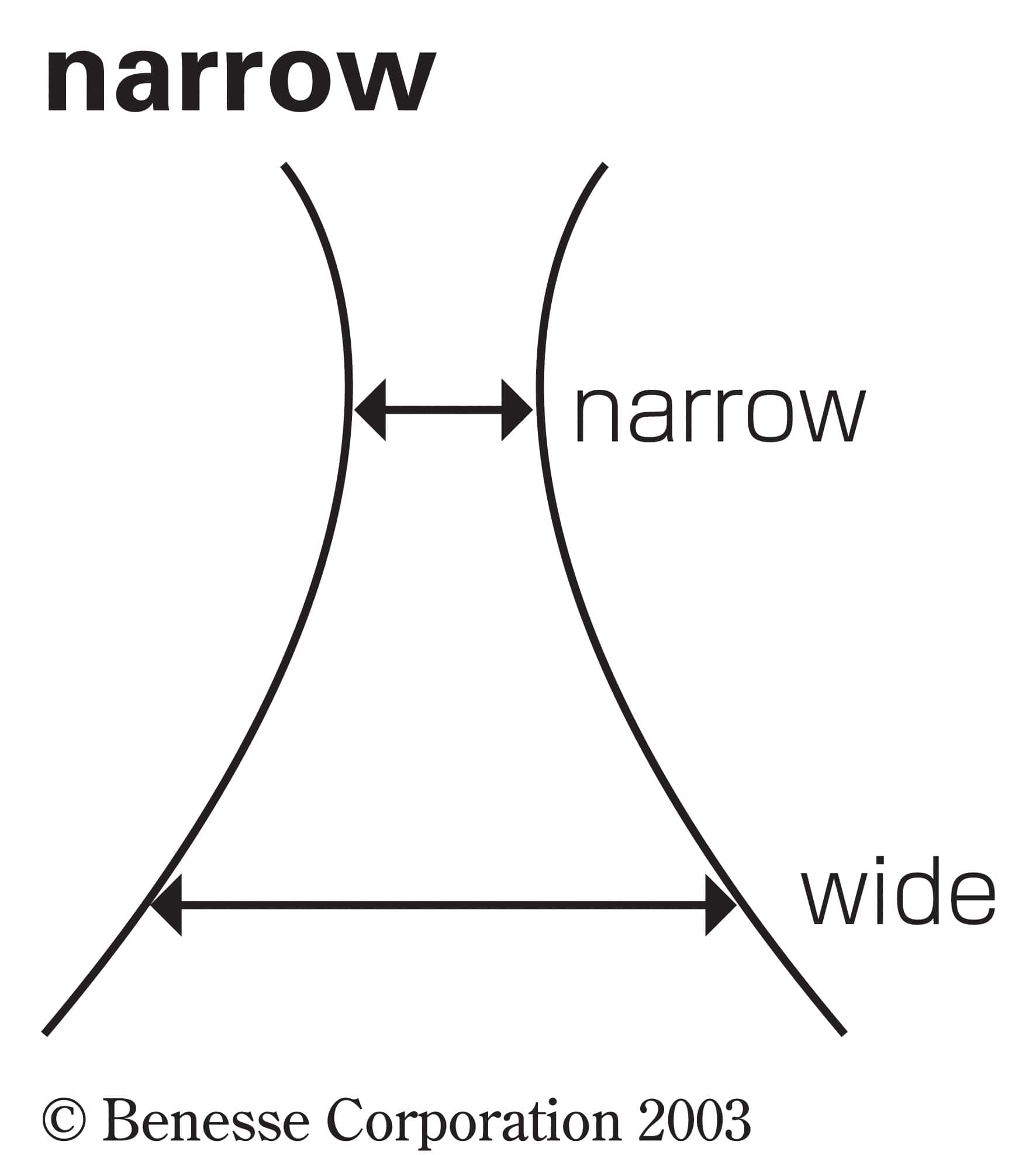
覚え方幅の狭い
形容詞
動詞
他動詞
自動詞
名詞
覚え方幅の狭い
 |
形容詞
1(幅が)狭い,細い(←→wide, broad)
2(範囲が)限られた,狭い;(意味が)狭い,狭義の
3(心・視野などが)狭い,狭量な
4((ふつう限定))かろうじての,やっとの
5((かたい))(調査などが)詳しい,厳密な
6(資力などが)乏しい
2(範囲が)限られた,狭い;(意味が)狭い,狭義の
3(心・視野などが)狭い,狭量な
4((ふつう限定))かろうじての,やっとの
5((かたい))(調査などが)詳しい,厳密な
|
6(資力などが)乏しい
動詞
他動詞
自動詞
名詞
ネットワーク狭い narrowは「幅が狭い,細い」という意味で用い,「空間的な広がりが狭い」ということを表す場合はsmallを用いる.例えば「狭い道」や「細いネクタイ」はそれぞれa narrow road, a narrow tieといい,空間的な狭さをいう「狭い部屋」や「狭い庭」はそれぞれa small room, a small gardenという.「世間は狭い」もIt's a small world.と表しnarrowは用いない |
 |
Weblio実用英語辞典

narrow
「narrow」は「狭い」「細い」「限定された」「心の狭い」といった意味を持つ形容詞、または「狭くする」「狭まる」という意味を持つ動詞、さらには「狭い道路」という意味を持つ名詞である。
動詞:狭くする、狭まる
名詞:狭い道路
1. The street was too narrow for the truck to pass.(その通りは狭すぎてトラックが通れなかった。)
2. She wore a dress with a narrow belt.(彼女は細いベルトの付いたドレスを着ていた。)
3. His knowledge of the subject is very narrow.(彼のその主題に関する知識は非常に限定されている。)
4. She criticized his narrow-minded approach to teaching.(彼女は彼の心の狭い教え方を批判した。)
5. The bridge was narrow and old.(その橋は狭くて古かった。)
1. The road narrows after the bridge.(橋の後で道は狭まる。)
2. The government plans to narrow the gap between rich and poor.(政府は富裕層と貧困層の差を狭める計画を立てている。)
3. Her eyes narrowed in suspicion.(彼女の目は疑いで細められた。)
4. The river narrows considerably as it passes through the canyon.(その川は峡谷を通過する際にかなり狭くなる。)
5. The list of candidates has narrowed to just three.(候補者のリストはたった3人に絞られた。)
1. The car got stuck in the narrow of the old town.(車は古い町の狭い道で立ち往生した。)
2. We walked single file down the narrow.(私たちは一列になって狭い道を歩いた。)
3. The narrow was too tight for a bicycle to navigate.(その狭い道は自転車が通るには狭すぎた。)
4. The delivery truck had trouble turning in the narrow.(配送トラックは狭い道を曲がるのに苦労した。)
5. Tourists often overlook the charm of the city's narrows.(観光客はしばしば、街の狭い道の魅力を見落とす。)
「narrow」とは・「narrow」の意味
形容詞:狭い、細い、限定された、心の狭い動詞:狭くする、狭まる
名詞:狭い道路
narrowの用法
形容詞
狭い、細い、限定された、心の狭い「narrow」が形容詞として使われる場合、物理的に幅や範囲が狭いこと、または考え方や見解が狭量であることを示す。具体的な例を以下に示す。
・例文1. The street was too narrow for the truck to pass.(その通りは狭すぎてトラックが通れなかった。)
2. She wore a dress with a narrow belt.(彼女は細いベルトの付いたドレスを着ていた。)
3. His knowledge of the subject is very narrow.(彼のその主題に関する知識は非常に限定されている。)
4. She criticized his narrow-minded approach to teaching.(彼女は彼の心の狭い教え方を批判した。)
5. The bridge was narrow and old.(その橋は狭くて古かった。)
動詞
狭くする、狭まる「narrow」が動詞として使われる場合、何かの幅を狭めること、または自然に幅が狭くなることを示す。具体的な例を以下に示す。
・例文1. The road narrows after the bridge.(橋の後で道は狭まる。)
2. The government plans to narrow the gap between rich and poor.(政府は富裕層と貧困層の差を狭める計画を立てている。)
3. Her eyes narrowed in suspicion.(彼女の目は疑いで細められた。)
4. The river narrows considerably as it passes through the canyon.(その川は峡谷を通過する際にかなり狭くなる。)
5. The list of candidates has narrowed to just three.(候補者のリストはたった3人に絞られた。)
名詞
狭い道路「narrow」が名詞として使われる場合、特に狭い道路や通路を指す。具体的な例を以下に示す。
・例文1. The car got stuck in the narrow of the old town.(車は古い町の狭い道で立ち往生した。)
2. We walked single file down the narrow.(私たちは一列になって狭い道を歩いた。)
3. The narrow was too tight for a bicycle to navigate.(その狭い道は自転車が通るには狭すぎた。)
4. The delivery truck had trouble turning in the narrow.(配送トラックは狭い道を曲がるのに苦労した。)
5. Tourists often overlook the charm of the city's narrows.(観光客はしばしば、街の狭い道の魅力を見落とす。)
ハイパー英語辞書

narrow
形容詞
動詞
名詞
- 用例
| 接尾辞 | ||
|---|---|---|
| -al | 「…に関する、…の性質の、…に特有の」などの意の形容詞を造る | |
日本語WordNet(英和)

narrow
動詞
形容詞
- 用例
- a narrow bridge 狭い橋
- a narrow line across the page ページを横切る細長い線
名詞
遺伝子名称シソーラス


Weblio英和対訳辞書
Wiktionary英語版
出典:Wiktionary
narrow
出典:『Wiktionary』 (2026/09/07 14:42 UTC 版)
別の表記
- narrowe (obsolete)
発音
語源 1
From 中期英語 narow, narowe, narewe, narwe, naru, from 古期英語 nearu (“narrow, strait, confined, constricted, not spacious, limited, petty; limited, poor, restricted; oppressive, causing anxiety (of that which restricts free action of body or mind), causing or accompanied by difficulty, hardship, oppressive; oppressed, not having free action; strict, severe”), from Proto-West Germanic *naru, from Proto-Germanic *narwaz (“constricted, narrow”), from Proto-Indo-European *(s)ner- (“to turn, bend, twist, constrict”).
形容詞
narrow (comparative narrower, superlative narrowest)
- Having a small width; not wide; having opposite edges or sides that are close, especially by comparison to length or depth.
-
a narrow hallway
-
2013 July-August, Catherine Clabby, “Focus on Everything”, in American Scientist, archived from the original on 7 September 2013:
-
Not long ago, it was difficult to produce photographs of tiny creatures with every part in focus. That’s because the lenses that are excellent at magnifying tiny subjects produce a narrow depth of field. A photo processing technique called focus stacking has changed that.
-
-
- Of little extent; very limited; circumscribed.
- (figuratively) Restrictive; without flexibility or latitude.
-
a narrow interpretation
-
- Contracted; of limited scope; bigoted.
- Having a small margin or degree.
-
a narrow escape
-
1970, Reading Reform Foundation, The Annual Reading Reform Foundation Conference, page 47:
-
Although we lost the election by the narrowest of margins, the people of Oregon heard a great deal about education, and particularly about how "look-say" reading instruction was hardshipping Oregon school children.
-
-
- (dated) Limited as to means; straitened
-
narrow circumstances
-
- Parsimonious; niggardly; covetous; selfish.
-
a. 1719, George Smalridge, The Hopes of a Recompense from Men must not be our chief Aim in doing Good:
-
a very narrow […] and stinted charity
-
-
- Scrutinizing in detail; close; accurate; exact.
- (phonetics) Formed (as a vowel) by a close position of some part of the tongue in relation to the palate; or (according to Bell) by a tense condition of the pharynx; distinguished from wide.
- (computing) Of or supporting only those text characters that can fit into the traditional 8-bit representation.
派生語
- go narrow
- narrow AI
- narrow angle
- narrow-angle lens
- narrow artificial intelligence
- narrow-assed
- narrowband
- narrow-banded dartwhite
- narrow bank
- narrow banking
- narrow-bellied seahorse
- narrowboat
- narrow boat
- narrowbody
- narrowcast
- narrow cloth
- narrow construction
- narrow-cut
- narrower
- narrow escape
- narrowfield
- narrow-fisted
- narrow-gage
- narrow-gauge, narrow gauge
- narrow-gutted
- narrowhead
- narrow house
- narrowing
- narrowish
- narrowleaf
- narrow-leaf ash
- narrow-leaved mallee
- narrow-leaved poison
- narrow-minded, narrow minded
- narrow mindedness
- narrow-nosed rhino
- narrow-nosed rhinoceros
- narrow road
- narrow sea
- narrow-sighted
- narrowsome
- narrow-souled
- narrow-spectrum
- narrow squeak
- narrow tailoring
- narrow transcription
- narrow-width effect
- narrow-winged tree cricket
- narrow work
- overnarrow
- straight and narrow
- supernarrow
- ultranarrow
- unnarrow
関連する語
名詞
語源 2
From 中期英語 narwen (“to narrow”); see there for more details, but ultimately derived from the noun.
動詞
narrow (third-person singular simple present narrows, present participle narrowing, simple past and past participle narrowed)
- (transitive) To reduce in width or extent; to contract.
- (intransitive) To get narrower.
- (of a person or eyes) To partially lower one's eyelids in a way usually taken to suggest a defensive, aggressive or penetrating look.
- (knitting) To contract the size of, as a stocking, by taking two stitches into one.
- (transitive, programming) To convert to a data type that cannot hold as many distinct values.
同意語
派生語
- narrowable
- narrow down
- narrow up
- renarrow
Weblio例文辞書


- Copyright (c) 1995-2026 Kenkyusha Co., Ltd. All rights reserved.
- Copyright © Benesse Holdings, Inc. All rights reserved.
- © 2000 - 2026 Hyper Dictionary, All rights reserved

- Copyright (C) 1994- Nichigai Associates, Inc., All rights reserved.
- 北里大学医療衛生学部 医療情報学研究室編集 医学用語集
- ※この記事は「北里大学医療衛生学部 医療情報学研究室」ホームページ内の「医学用語集」(2001.06.10. 改訂)の情報を転載しております。

- Copyright (C) 2026 ライフサイエンス辞書プロジェクト
- 日本語ワードネット1.1版 (C) 情報通信研究機構, 2009-2010 License All rights reserved.
WordNet 3.0 Copyright 2006 by Princeton University. All rights reserved. License

- Copyright © 2026 CJKI. All Rights Reserved
- DBCLS Home Page by DBCLS is licensed under a Creative Commons 表示 2.1 日本 License.

- Copyright (C) 1994- Nichigai Associates, Inc., All rights reserved.
「斎藤和英大辞典」斎藤秀三郎著、日外アソシエーツ辞書編集部編
- Wiktionary
- Text is available under Creative Commons Attribution-ShareAlike (CC-BY-SA) and/or GNU Free Documentation License (GFDL).
Weblio英和・和英辞典に掲載されている「Wiktionary英語版」の記事は、Wiktionaryのnarrow (改訂履歴)の記事を複製、再配布したものにあたり、Creative Commons Attribution-ShareAlike (CC-BY-SA)もしくはGNU Free Documentation Licenseというライセンスの下で提供されています。
- CMUdict
- CMUdict is Copyright (C) 1993-2008 by Carnegie Mellon University.
