

研究社 新英和中辞典

lift
lift /líft/

1 持ち上げる 《★【類語】 lift は物を持ち上げる; raise は特に一方の端を持ち,直立または高い位置に上げる; hoist は重い物を,特に機械などの力を借りて持ち上げる》:
a 〔+目的語(+副詞(句))〕〈ものを〉持ち[引き]上げる; 抱き上げる.
b 〔+目的語+down+from+(代)名詞〕〈…を〉〔…から〕(いったん持ち上げてから)取って下ろす.
c 〔+目的語(+up)〕〈目・顔などを〉上げる.
d 〈箱のふたなどを〉あける,はずす.
2 a 〔+目的語+副詞(句)〕〈人を〉向上させる,〈人の〉地位[境遇]を高める.
b 〔+目的語+副詞(句)〕[lift oneself で] 身を起こす,向上する.
c 〔+目的語(+up)〕〈元気・気力を〉引き立てる.
3 〔+目的語(+up)〕〈声を〉高める; 〈叫び声を〉上げる.
4 〔+目的語+to+(代)名詞〕〈荷・乗客などを〉〔…へ〕空輸する; 運ぶ,乗せていく.
5 〈根菜作物を〉掘り上げる.
6 a 〈テントを〉取り除く.
b 〈封鎖・包囲などを〉解く.
7 〔+目的語(+from+(代)名詞)〕《口語》〈ものを〉〔…から〕盗む; 〈他人の文章を〉盗む,剽窃(ひようせつ)する.
8 《主に米国で用いられる》〈負債・抵当金などを〉支払う,皆済する.
9 (整形術で)〈顔の〉しわを取る[伸ばす].
1 持ち上がる.
2 a 〈雲・霧・雨などが〉晴れる,上がる.
b 〈表情が〉晴れる.
3 〔動詞(+off)〕〈飛行機・宇宙船などが〉離陸する; 離昇[発進]する.
1 可算名詞
a 持ち[引き]上げること; 揚げること.
b 持ち上げた距離,上昇距離 〔of〕.
c (1 回で持ち上げる[上がる])重量(物), 荷.
2 可算名詞
a (身分・地位の)昇進,昇級,立身出世 〔in〕.
b (物価・景気などの)上昇 〔in〕.
3 [a lift] (精神の)高揚,(感情の)高潮.
4 可算名詞 [通例単数形で] (歩行者を)車に乗せること; 手助け,手伝い.
5 可算名詞
a 《主に英国で用いられる》 エレベーター,昇降機 (《主に米国で用いられる》 elevator).
b (小形の)貨物エレベーター.
c 起重機.
d (スキーヤーを運ぶ)リフト.
6 可算名詞
a 空輸.
b 輸送.
7 不可算名詞 揚力.
動詞 他動詞
- 用例
-
- 用例
-
- lift one's head from the morning paper 朝刊から顔を上げる.
- 用例
-
- lift (up) one's heart [spirits] 元気を出す.
自動詞
名詞
- 用例
-
- 用例
-
- ⇒ski lift.
【語源】
調べた例文を記録して、効率よく覚えましょう
Weblio会員無料で登録できます
 履歴機能
過去に調べた単語を確認できる
履歴機能
過去に調べた単語を確認できる
 語彙力診断
診断回数が4回に増加
語彙力診断
診断回数が4回に増加
 マイ単語帳
便利な学習機能付き
マイ単語帳
便利な学習機能付き
 マイ例文帳
文章で意味を理解できる
マイ例文帳
文章で意味を理解できる
Eゲイト英和辞典

lift
音節lift発音記号・読み方lɪ́ft変化~s{-ts}; ~・ed{~ɪd}; ~・ing
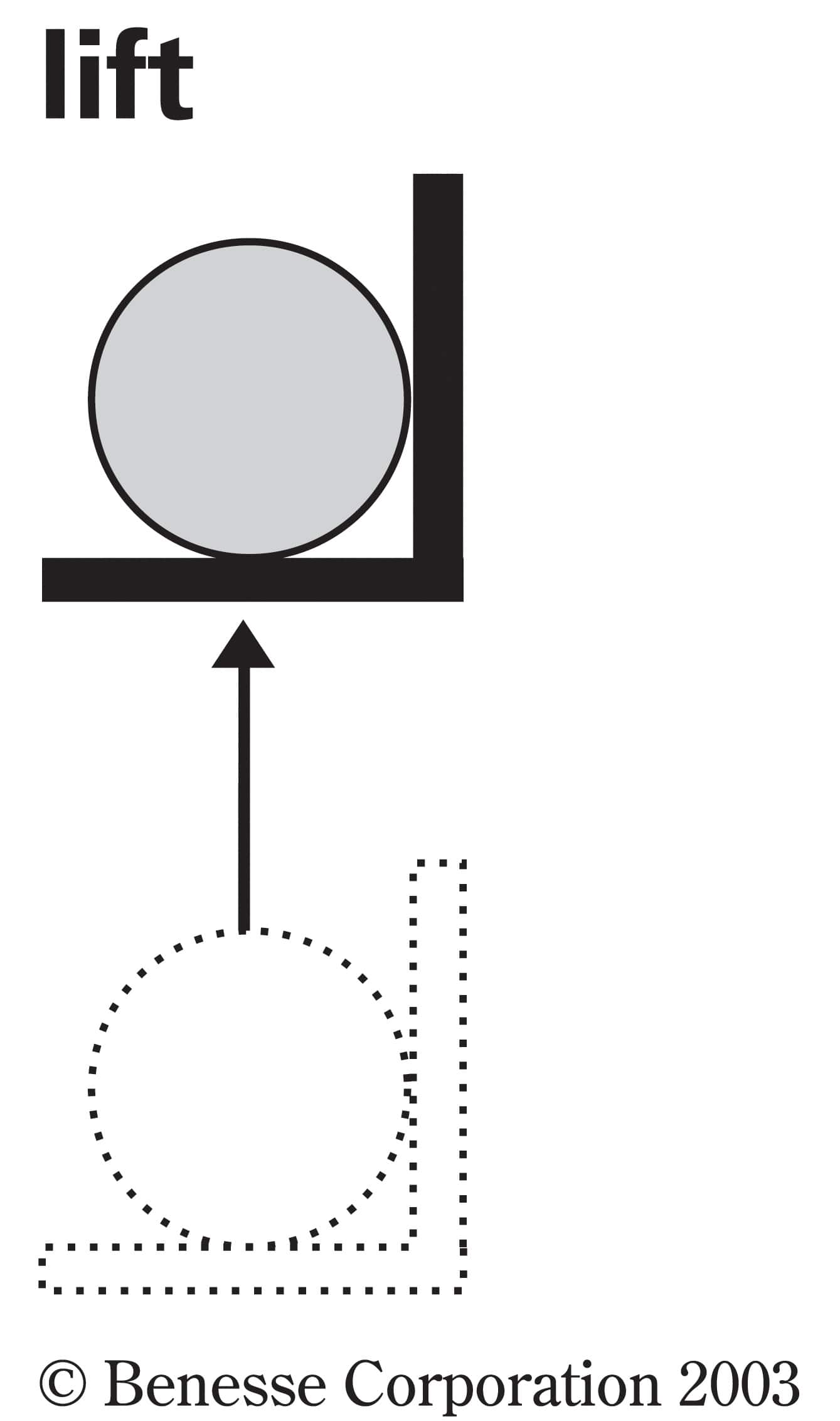
覚え方(まっすぐ)持ち上げる
動詞
自動詞
名詞
覚え方(まっすぐ)持ち上げる
 |
動詞
―他動詞1…を持ち上げる;…を持ち上げて移動する;(顔・目・手など)を上げる
2…を運ぶ;(乗客など)を空輸する
3(封鎖・禁止など)を解除する,やめる
4(精神・士気など)を高揚する,向上させる
5((口))(文章など)の一部を盗用する
6((口))…を万引きする
7(声など)を張り上げる
8(美容整形で)(顔)のしわとり手術をする
|
2…を運ぶ;(乗客など)を空輸する
3(封鎖・禁止など)を解除する,やめる
4(精神・士気など)を高揚する,向上させる
5((口))(文章など)の一部を盗用する
6((口))…を万引きする
7(声など)を張り上げる
8(美容整形で)(顔)のしわとり手術をする
自動詞
名詞
コア・セオリー英語表現(基本動詞)

lift
| コアとなる意味 | (まっすぐ)持ち上げる |
①...を持ち上げる ;...を持ち上げて移動する;(顔・目・手など)を上げる
- He tried to lift the stone, but it was too heavy for him.
彼はその石を持ち上げようとしたが,余りにも重すぎました - She lifted an old book out of her grandfather's trunk.
彼女は祖父のトランクから古い本を持ち上げて取り出した - Please lift this pan onto the stove.
この鍋を持ち上げてガスコンロの上に置いてください - The student lifted his hand in the air to signal the teacher that he knew the answer.
その学生は手を上に上げて答が分かったと合図をした - Women seldom lift their eyes to look at men in this country.
この国では、女性は男性に対して目を上げて見ません - He lifted his gaze to the snow-covered summit of the mountain.
彼は雪のかぶった山を目を上げてじっと見つめた

日本語WordNet(英和)

lift
動詞
- 用例
- lift the tulip bulbs チューリップの球根を持ち上げる
名詞
Weblio英和対訳辞書

Lift
Lift
lift
lift
lift
lift
Weblio英和対訳辞書はプログラムで機械的に意味や英語表現を生成しているため、不適切な項目が含まれていることもあります。ご了承くださいませ。
Wiktionary英語版
出典:Wiktionary
lift
出典:『Wiktionary』 (2026/09/04 18:03 UTC 版)
語源 1
From 中期英語 liften, lyften, from Old Norse lypta (“to lift, air”, literally “to raise in the air”), from Proto-Germanic *luftijaną (“to raise in the air”), related to *luftuz (“roof, air”), perhaps from Proto-Indo-European *lewp- (“to peel, break off, damage”) or from a root meaning roof (see *luftuz). Cognate with Danish and Norwegian Bokmål løfte (“to lift”), Norwegian Nynorsk and Swedish lyfta (“to lift”), German lüften (“to air, lift”), 古期英語 lyft (“air”). See above. 1851 for the noun sense "a mechanical device for vertical transport".
(To steal): For this sense Cleasby suggests perhaps a relation to the root of Gothic 𐌷𐌻𐌹𐍆𐍄𐌿𐍃 (hliftus) "thief", cognate with Latin cleptus and Greek κλέπτω (kléptō)). But perhaps simply from the idea of removing an item from a surface.
動詞
lift (third-person singular simple present lifts, present participle lifting, simple past lifted or (rare, regional, obsolete) lift, past participle lifted or (rare, regional, obsolete) lift or (obsolete) yleft)
- (ambitransitive) To raise or rise.
- c. 1490, Of Penance and Confession be master Jhon Yrlandː
-
1900, Charles W[addell] Chesnutt, chapter I, in The House Behind the Cedars, Boston, Mass.; New York, N.Y.: Houghton, Mifflin and Company […], →OCLC:
-
Their walk had continued not more than ten minutes when they crossed a creek by a wooden bridge and came to a row of mean houses standing flush with the street. At the door of one, an old black woman had stooped to lift a large basket, piled high with laundered clothes.
-
-
1984 October 12, Janet Maslin, “Blood Simple, A black-comic romp”, in The New York Times, retrieved 9 July 2012:
- (transitive) To cause to move upwards.
- (transitive, slang) To steal.
-
1960, P[elham] G[renville] Wodehouse, chapter VI, in Jeeves in the Offing, London: Herbert Jenkins, →OCLC:
-
“Wilbert Cream is a ... what's the word?” I referred to the letter. “A kleptomaniac […] Does any thought occur to you?” “It most certainly does. I am thinking of your uncle's collection of old silver.” “Me, too.” “It presents a grave temptation to the unhappy young man.” “I don't know that I'd call him unhappy. He probably thoroughly enjoys lifting the stuff.”
-
- (transitive, slang) To source directly without acknowledgement; to plagiarise.
-
2018, James Lambert, “Anglo-Indian slang in dictionaries on historical principles”, in World Englishes, volume 37, page 258:
-
Based on a similarity across a range of Anglo-Indian entries in these three dictionaries, it appears that (along with other lexis) Barrère and Leland (1898) copied this entry from Hotten (1864), who had in turn lifted it directly from Stocqueler (1848).
-
-
- (transitive, slang) To arrest (a person).
-
2000, Marie Smyth, Marie-Therese Fay, Personal Accounts From Northern Ireland's Troubles:
-
Maybe the police lifted him and he's in Castlereagh [Interrogation Centre] because he'd been lifted three or four times previously and took to Castlereagh. They used to come in and raid the house and take him away.
-
-
- (transitive) To remove (a ban, restriction, etc.).
- (transitive) To alleviate, to lighten (pressure, tension, stress, etc.)
- (intransitive, especially Scotland) To disperse, to break up.
- (informal, intransitive) To lift weights; to weight-lift.
- To try to raise something; to exert the strength for raising or bearing.
- To elevate or improve in rank, condition, etc.; often with up.
- (obsolete) To bear; to support.
- To collect, as moneys due; to raise.
- (category theory, transitive) Given morphisms
and
with the same target: To produce a morphism which the given morphism factors through (i.e. a morphism
such that
; cf. lift n.etymology 1, noun 20)
- (programming) To transform (a function) into a corresponding function in a different context.
- (programming) To transform (a function) into a corresponding function in a different context.
- (finance) To buy a security or other asset previously offered for sale.
- (hunting, transitive) To take (hounds) off the existing scent and move them to another spot.
使用する際の注意点
Lift also has an obsolete form liftand for the present participle. The strong forms were common until the 17th century in writing and still survive in speech in a few rural dialects.
下位語
派生語
- airlift
- code-lift
- forelift
- liftable
- lift a finger
- lift a finger against
- lift all boats
- lift and separate
- lift and shift
- lift down
- lifting
- lift off
- lift oneself up by one's bootstraps
- lift oneself up by one's boot-tags
- lift oneself up by one's own bootstraps
- lift oneself up by one's own boot-tags
- lift oneself up by one's own waistbands
- lift one's game
- lift someone's spirits
- lift the bar
- lift the lid
- lift up
- lift-up
- outlift
- relift
- shoplift
- uplift
名詞
lift (countable and uncountable, plural lifts)
- An act of lifting or raising.
- The act of transporting someone in a vehicle; a ride; a trip.
-
1913, Arthur Conan Doyle, “(please specify the page)”, in The Poison Belt […], London; New York, N.Y.: Hodder and Stoughton, →OCLC:
-
Accordingly, in spite of many grumbles and remonstrances from Summerlee, I ordered an additional tube, which was placed with the other in his motor-car, for he had offered me a lift to Victoria.
-
-
- (UK, Australia, New Zealand, India, puristic elsewhere) A mechanical device for vertically transporting goods or people between floors in a building.
-
1913, Marie Adelaide Belloc Lowndes, The Lodger:
-
- A mechanical device for raising vehicles for service, so that it is easier for a mechanic to get beneath them.
- An upward force; especially, the force (generated by wings, rotary wings, or airfoils) that keeps aircraft aloft.
- (weightlifting) Any technique for lifting weights.
- (measurement) The difference in elevation between the upper pool and lower pool of a waterway, separated by lock.
- (historical slang) A thief.
- (dance) The lifting of a dance partner into the air.
- Permanent construction with a built-in platform that is lifted vertically.
- (figurative) An improvement in mood.
- The amount or weight to be lifted.
- The space or distance through which anything is lifted.
- A rise; a degree of elevation.
- A liftgate.
- (nautical) A rope leading from the masthead to the extremity of a yard below, and used for raising or supporting the end of the yard.
- (engineering) One of the steps of a cone pulley.
- (shoemaking) A layer of leather in the heel of a shoe.
- (horology) That portion of the vibration of a balance during which the impulse is given.
- (category theory) A morphism which some given morphism factors through; i.e. given a pair of morphisms
and
, a morphism
such that
. (In this case
is said to be a lift of
via
or via
).
- (broadcasting) A shorter extract from a commercial/advertisement, able to be used on its own.
派生語
- aerial lift
- airlift
- arse lift
- ass lift
- backlift
- bike lift
- boat lift, boatlift
- booklift
- Brazilian butt lift
- breastlift
- browlift
- butt lift
- button lift
- center of lift, centre of lift
- chairlift
- cliff lift
- counterpoise-lift
- cowlift
- deadlift
- draglift
- eyelift, eye lift
- facelift
- faith-lift
- fireman's lift
- forklift
- give someone a lift
- gondola lift
- gum lift
- hairlift
- haylift
- heavy lift
- heel lift
- high-lift device
- inclined lift
- incline lift
- lash lift
- liftback
- liftboy
- lift bridge
- lift car
- lift club
- lift girl
- liftless
- liftline
- lift lockdown
- liftman
- lift music
- lift net
- lift-off
- liftover
- lift pass
- lift pump
- lift scheme
- liftshaft
- lift shaft
- lift surfing
- lift-to-drag ratio
- lift truck
- manlift
- man lift
- necklift
- noselift
- platter lift
- Poma lift
- race lift
- rook lift
- scissor lift
- sealift
- service lift
- ship lift
- shoe lift
- ski lift
- skylift
- stairlift
- stair lift
- surface lift
- tail lift
- thumb a lift
- topping lift
- trooplift
- turbolift
- vertical-lift bridge
- vertical lift module
- voice lift
- wheelchair lift
派生した語
参考
語源 2
From 中期英語 lifte, luft, lefte (“air, sky, heaven”), from 古期英語 lyft (“atmosphere, air”), from Proto-West Germanic *luftu, from Proto-Germanic *luftuz (“roof, sky, air”), from Proto-Indo-European *lewp- (“to peel, break off, damage”).
Cognate with Old High German luft (“air”) (German Luft), Dutch lucht (“air”), Old Norse lopt, loft (“upper room, sky, air”). Doublet of loft and luft.
名詞
lift (usually uncountable, plural lifts)
同意語
参照
発音
- IPA: /lift/
参照
- “lift, adj.”, in MED Online, Ann Arbor, Mich.: University of Michigan, 2007.
Weblio例文辞書
lift
2
例文
3
例文
4
例文
例文
6
例文
7
例文
8
例文
9
例文
10
11
13
例文
14
例文
15
例文
16
例文
例文
the overhang
18
例文
rudds
19
例文
20
21
22
23
例文
24
例文
25
例文
26
例文
27
例文
28
例文
29
30
ふた
Weblio例文辞書はプログラムで機械的に意味や英語表現を生成しているため、不適切な項目が含まれていることもあります。ご了承くださいませ。


- Copyright (c) 1995-2026 Kenkyusha Co., Ltd. All rights reserved.
- Copyright © Benesse Holdings, Inc. All rights reserved.
- Copyright (C) 2026 田中茂範 All rights reserved.

- © 2000 - 2026 Hyper Dictionary, All rights reserved

- Copyright (C) 1994- Nichigai Associates, Inc., All rights reserved.

- Copyright (C) 2026 安藤設計事務所 All rights reserved.

- DBCLS Home Page by DBCLS is licensed under a Creative Commons 表示 2.1 日本 License.

- All Rights Reserved, Copyright © Japan Science and Technology Agency


- ※この記事は『「多国語防災用語集」国際防災の十年(IDNDR)国民会議』の内容を転載しております。

- Copyright (C) 2026 社団法人日本実験動物学会 All rights reserved.
- 日本語ワードネット1.1版 (C) 情報通信研究機構, 2009-2010 License All rights reserved.
WordNet 3.0 Copyright 2006 by Princeton University. All rights reserved. License

- Copyright(C)2002-2026 National Institute of Information and Communications Technology. All Rights Reserved.

- Copyright © 2026 CJKI. All Rights Reserved

- Copyright (C) 1994- Nichigai Associates, Inc., All rights reserved.
「斎藤和英大辞典」斎藤秀三郎著、日外アソシエーツ辞書編集部編
- Wiktionary
- Text is available under Creative Commons Attribution-ShareAlike (CC-BY-SA) and/or GNU Free Documentation License (GFDL).
Weblio英和・和英辞典に掲載されている「Wiktionary英語版」の記事は、Wiktionaryのlift (改訂履歴)の記事を複製、再配布したものにあたり、Creative Commons Attribution-ShareAlike (CC-BY-SA)もしくはGNU Free Documentation Licenseというライセンスの下で提供されています。
- CMUdict
- CMUdict is Copyright (C) 1993-2008 by Carnegie Mellon University.
