

研究社 新英和中辞典

tight
tight /tάɪt/

1 a 堅く結んだ,堅い,きつい.
b 〈栓・ねじなど〉しっかり固定した; 〈引き出しなど〉きつ(くてあけにく)い.
2 a 空気[水(など)]の漏らない.
b [通例複合語をなして] (…の)通らない,防…,耐….
3 a 〈ロープなど〉ぴんと張った (⇔slack,→loose).
b 〈微笑など〉引きつった,こわばった.
4 a 〈衣服など〉きちんと合った; (特に)きつい,窮屈な (⇔easy).
b 〈胸の感じなど〉締めつけられるような.
5 a 〈布地など〉締まった,目のつんだ.
b 〈袋など〉いっぱいになった,ぎっしりつまった.
c 〈予定など〉いっぱいつまった,ぎっしりの.
6 a 金づまりの,〈金融が〉逼迫(ひつぱく)した.
b 〈取引が〉少ない; 〈商売が〉あまりもうからない,きつい.
7 〈立場など〉やっかいな,困難な; 苦境にある.
8 〈管理・取り締まりなど〉厳しい,厳格な.
9 《口語》 しまり屋の,けちな.
10 《口語》 ほとんど互角の.
11 《口語》 酔った.
1 堅く,しっかりと,きつく.
2 十分に,ぐっすり.
形容詞
- 用例
-
- ⇒airtight, →watertight.
- 用例
- 用例
-
副詞
- 用例
-
- close one's eyes tight 目をかたく閉じる.
名詞
tightness 名詞
【語源】
調べた例文を記録して、効率よく覚えましょう
Weblio会員無料で登録できます
 履歴機能
過去に調べた単語を確認できる
履歴機能
過去に調べた単語を確認できる
 語彙力診断
診断回数が4回に増加
語彙力診断
診断回数が4回に増加
 マイ単語帳
便利な学習機能付き
マイ単語帳
便利な学習機能付き
 マイ例文帳
文章で意味を理解できる
マイ例文帳
文章で意味を理解できる
Eゲイト英和辞典

tight
音節tight発音記号・読み方táɪt変化~・er; ~・est
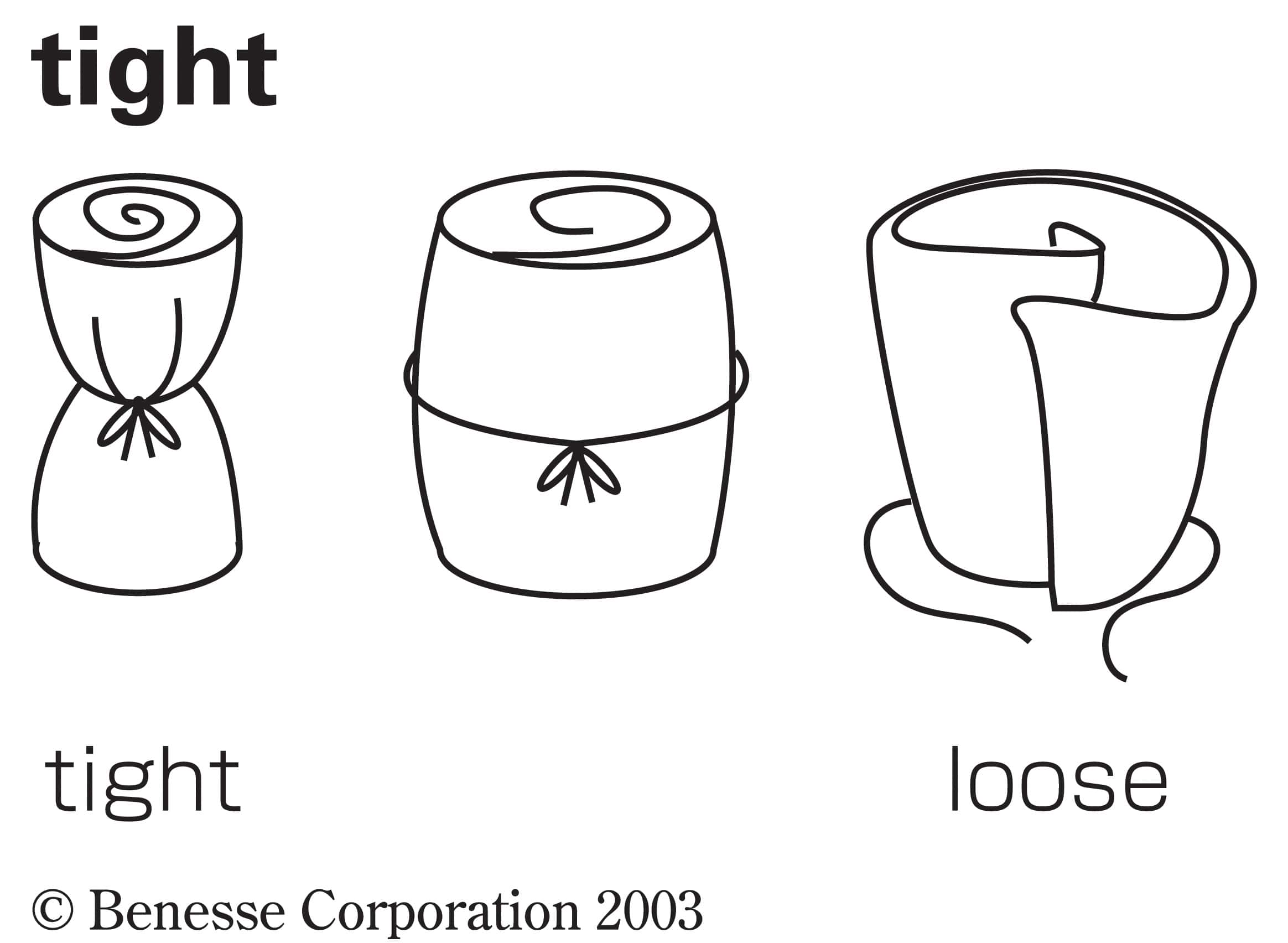
覚え方詰まってすき間のない
形容詞
副詞
覚え方詰まってすき間のない
 |
形容詞
1きつい,堅くしまった
2ぴんと張った;引き締まった
3(服などが)きつい,ぴったりした
4(時間的・空間的に)すき間のない,ぎっしり詰まった;目が詰まった;(水などの)漏れない
5厳格な,厳しい,きちんとした
6困難な,窮地の;((ふつう叙述))(経済的に)逼迫(ひつぱく)した,厳しい;(商品などが)不足して
7((口))互角の,接戦の,伯仲の
8((ふつう叙述))((口))けちな(←財布のひもがきついことから)
9親しい(←関係が密なことから)
10((ふつう叙述))((口))酔っ払った
2ぴんと張った;引き締まった
3(服などが)きつい,ぴったりした
4(時間的・空間的に)すき間のない,ぎっしり詰まった;目が詰まった;(水などの)漏れない
5厳格な,厳しい,きちんとした
6困難な,窮地の;((ふつう叙述))(経済的に)逼迫(ひつぱく)した,厳しい;(商品などが)不足して
7((口))互角の,接戦の,伯仲の
8((ふつう叙述))((口))けちな(←財布のひもがきついことから)
9親しい(←関係が密なことから)
10((ふつう叙述))((口))酔っ払った
副詞
日本語WordNet(英和)

tight
副詞
形容詞
- 用例
- 用例
Wiktionary英語版
出典:Wiktionary
tight
出典:『Wiktionary』 (2026/05/09 17:10 UTC 版)
語源 1
From 中期英語 tight, tyght, tyȝt, tiht, variants of thight, thiht, from 古期英語 *þiht, *þīht (attested in meteþiht), from Proto-West Germanic *þį̄ht(ī), from Proto-Germanic *þinhtaz, from Proto-Indo-European *tenkt- (“dense, thick, tight”), from Proto-Indo-European *ten- (“to stretch, pull”).
Cognate with Scots ticht, West Frisian ticht, Danish tæt, Icelandic þéttur (“dense”), Norwegian tett, Swedish tät, Dutch dicht (“dense”), German dicht (“dense”).
The current form with t- /t/ rather than etymologically-expected th- /θ/ arose in 中期英語 under the influence of the etymologically-unrelated verbs tighten and tight, which come from a different Proto-Indo-European root (starting with *d- and thus regularly having t-).
形容詞
tight (comparative tighter, superlative tightest)
- Firmly held together; compact; not loose or open.
- Unyielding or firm.
- Under high tension; taut.
- (colloquial) Scarce, hard to come by.
- (informal, figurative, of persons or relationships) Intimate, close, close-knit, intimately friendly.
- (slang, figurative, usually derogatory) Miserly or frugal.
- (slang) Short of money.
- (of a space, design or arrangement) Narrow, such that it is difficult for something or someone to pass through it.
- Well-rehearsed and accurate in execution.
- (slang) Intoxicated; drunk.
-
c. 1930, Dominic Behan, “Come Out Ye Black and Tans”performed by The Wolfe Tones:
-
And every single night when me da’ would come home tight he’d invite the neighbours out with this chorus.
-
-
1940, Effie Butler, Misbehaving Husbands:
-
I'm going to celebrate my divorce! And then I'm going to get tight.
-
-
1955, J. D. Salinger, “Franny”, in Franny and Zooey, Boston, Mass.: Little, Brown and Company, published 1991, →ISBN, page 5:
-
Do you actually know I’ve only danced with you twice in eleven months? Not counting that time at the Vanguard when you were so tight.
-
-
1975, Walter Becker, Donald Fagen, “Daddy Don't Live in That New York City No More”, performed by Steely Dan:
-
No my daddy don't live in that New York City no more, no more / He can't get tight every night, pass out on the barroom floor
-
- (slang) Extraordinarily great or special.
- (slang, Northern England, chiefly Liverpool) Mean; unfair; unkind.
- (of time) Limited or restricted.
- (obsolete) Not ragged; whole; neat; tidy.
-
1907 August, Robert W[illiam] Chambers, chapter IX, in The Younger Set, New York, N.Y.: D. Appleton & Company, →OCLC:
-
“A tight little craft,” was Austin’s invariable comment on the matron; and she looked it, always trim and trig and smooth of surface like a converted yacht cleared for action. ¶ Near her wandered her husband […] from time to time squinting sideways, as usual, in the ever-renewed expectation that he might catch a glimpse of his stiff, retroussé moustache.
-
- (obsolete) Handy; adroit; brisk.
- (poker) Of a player, who plays very few hands. (Can we add an example for this sense?)
- (poker) Using a strategy which involves playing very few hands. (Can we add an example for this sense?)
- (US, slang, motor racing) With understeer, primarily used to describe NASCAR stock cars.
- (New York, slang) Angry or irritated.
- (slang, vulgar) Of a person, having a tight vagina or anus.
同意語
- (firmly held together): close, serried (of ranks); see also Thesaurus:tight
- (pushed/pulled together): crowded, dense; see also Thesaurus:compact
- (under high tension): taut, tense, under tension; see also Thesaurus:taut
- (intimate, close, close-knit): close, close-knit, intimate, thick as thieves
- (miserly or frugal): niggardly, parsimonious; see also Thesaurus:stingy
- (narrow): narrow; see also Thesaurus:narrow
- (fitting close to the body): figure-hugging, snug, tight-fitting; see also Thesaurus:close-fitting
- (well-rehearsed and accurate): polished, precise; see also Thesaurus:meticulous
- (slang: intoxicated): blotto, plastered; see also Thesaurus:drunk
- (slang: extraordinarily great or special): ace, cool, fab, rad, slick; see also Thesaurus:excellent
- (slang: mean; unfair; unkind): see also Thesaurus:mean
- (not ragged): ruly, shipshape, trim; see also Thesaurus:orderly
- (handy; adroit; brisk): crafty, dexterous, skilful; see also Thesaurus:skilled
反意語
- (antonym(s) of “firmly held together”): baggy (of clothing or other material), loose, sagging, saggy, slack; see also Thesaurus:loose
- (antonym(s) of “pushed/pulled together”):
- (antonym(s) of “under high tension”): loose, relaxed, slack; see also Thesaurus:careless
- (antonym(s) of “miserly or frugal”): generous, prodigal, scattergood; see also Thesaurus:generous or Thesaurus:prodigal
- (antonym(s) of “narrow”): broad, capacious, open, roomy, spacious, wide; see also Thesaurus:wide
- (antonym(s) of “well-rehearsed and accurate”): slack, slapdash, sloppy
- (antonym(s) of “slang: intoxicated”): clearheaded, on the wagon; see also Thesaurus:sober
- (antonym(s) of “slang: extraordinarily great or special”): crap, naff, pathetic, rubbish; see also Thesaurus:bad
- (antonym(s) of “slang: mean; unfair; unkind”): nice, pleasant; see also Thesaurus:kindly
- (antonym(s) of “not ragged”): unruly, messy; see also Thesaurus:disorderly
- (antonym(s) of “handy; adroit; brisk”): bungling, maladroit, unskilful; see also Thesaurus:unskilled
派生語
- airtight
- as tight as a duck's arse, tight as a duck's arse
- as tight as a gnat's chuff, tight as a gnat's chuff
- as tight as Dick's hatband
- blow me tight
- bottle-tight
- finger-tight
- finger tight
- hand-tight
- hang tight
- high and tight
- hog tight
- hug-me-tight
- in tight
- keep a tight rein on
- not wrapped too tight
- on a tight leash
- overtight
- skintight
- smoketight
- stick-tight
- sticktight
- sun-tight
- supertight
- tight-arse
- tight-arsed
- tight as a drum
- tight as a duck's ass
- tight as a tick
- tight as Dick's hatband
- tightass
- tight-assed
- tightbeam
- tight building syndrome
- tight closure
- tight-collar
- tighten
- tight end
- tighter than Dick's hatband
- tighter than wallpaper
- tight-fisted
- tight-fitting
- tight five
- tighthead
- tighties
- tightish
- tight junction
- tightknit
- tight-knit
- tight-laced
- tightlacer
- tightlacing
- tight lattice
- tight-lipped
- tight lips
- tightlock
- tight loop
- tightly
- tight money
- tightness
- tight oil
- tight pants syndrome
- tightrope
- tights
- tight scratch
- tight ship
- tight slap
- tightsome
- tight spot
- tightwad
- tight whites
- tightwire
- tighty whities
- ultratight
- untight
- uptight
- vaportight
- weapons tight
- windtight
副詞
tight (comparative tighter, superlative tightest)
- Firmly, so as not to come loose easily.
- Soundly.
-
Good night, sleep tight.
-
派生語
動詞
tight (third-person singular simple present tights, present participle tighting, simple past and past participle tighted)
Weblio例文辞書



- Copyright (c) 1995-2026 Kenkyusha Co., Ltd. All rights reserved.
- Copyright © Benesse Holdings, Inc. All rights reserved.

- © 2000 - 2026 Hyper Dictionary, All rights reserved

- Copyright (C) 1994- Nichigai Associates, Inc., All rights reserved.

- Copyright (C) 1994- Nichigai Associates, Inc., All rights reserved.

- Copyright (C) 医療法人社団 医新会 All Right Reserved.

- Copyright (C) 2026 ライフサイエンス辞書プロジェクト
- 日本語ワードネット1.1版 (C) 情報通信研究機構, 2009-2010 License All rights reserved.
WordNet 3.0 Copyright 2006 by Princeton University. All rights reserved. License

- Copyright © 2026 CJKI. All Rights Reserved

- Copyright (C) 1994- Nichigai Associates, Inc., All rights reserved.
「斎藤和英大辞典」斎藤秀三郎著、日外アソシエーツ辞書編集部編
- Wiktionary
- Text is available under Creative Commons Attribution-ShareAlike (CC-BY-SA) and/or GNU Free Documentation License (GFDL).
Weblio英和・和英辞典に掲載されている「Wiktionary英語版」の記事は、Wiktionaryのtight (改訂履歴)の記事を複製、再配布したものにあたり、Creative Commons Attribution-ShareAlike (CC-BY-SA)もしくはGNU Free Documentation Licenseというライセンスの下で提供されています。
- CMUdict
- CMUdict is Copyright (C) 1993-2008 by Carnegie Mellon University.
