

研究社 新英和中辞典

full1
full /fˈʊl/

1 a 〈容器など〉(ほぼ)いっぱいの,満ちた; (比較なし)満杯の,あふれるほどの.
b 叙述的用法の形容詞 〔+of+(代)名〕〔…で〕いっぱいで; (比較なし)あふれて.
c 〈乗り物・場所など〉満員の,満載の.
d 叙述的用法の形容詞 〔+of+(代)名〕〔人・もので〕いっぱいで,混雑して,満載で.
e 《口語》 満腹の; 胸いっぱいの.
f 叙述的用法の形容詞 〔+of+(代)名〕〔…で〕頭がいっぱいになって,〔…に〕夢中になって.
2 a 限定用法の形容詞 [数・量を表わす語とともに用いて] まる(まる).
b 十分な,盛りの,満…の.
c 限定用法の形容詞 (比較なし)(資格が)正式の.
3 限定用法の形容詞 (比較なし)最高の,最大限の,精いっぱいの.
4 a たくさんの,豊かな,たっぷりの.
b 充実した.
c (内容が)いっぱいの,つまった.
d 叙述的用法の形容詞 〔+of+(代)名〕〔…が〕多くて,たくさんいて.
5 a 〈形・体型・顔など〉ふっくらした,豊満な; 太った.
b 叙述的用法の形容詞 〔+in+(代)名〕〔…が〕ふっくらして; 太って.
c 〈衣服が〉ゆとりのある,だぶだぶの,ゆるやかな.
6 限定用法の形容詞
a 〈声量が〉豊かな.
b 〈ぶどう酒が〉こくのある
7 〈兄弟が〉同父母の.
8 【航海, 海語】〈帆が〉風をはらんだ; 〈船が〉帆に風をはらませた.
9 《英俗》 酔った.
1 きっかり,ちょうど,まともに.
2 a [full well で] 非常に.
b [形容詞・副詞を修飾して] 《文語》 まったく,非常に.
3 [数量詞に伴って] 十分に,まる… 《★現在では fully を用いる》.
1 全部; 十分 《★【用法】 whole のほうが一般的》.
2 (季節・月などの)真っ盛り,絶頂.
形容詞
- 用例
-
- a full cup of tea カップいっぱいのお茶.
- 用例
-
- be full of one's own affairs 自分のことでいっぱいだ.
- 用例
-
- 用例
-
- a full and fruitful life 充実して実り多い人生.
副詞
(比較なし)
名詞不可算名詞
動詞 他動詞
自動詞
【語源】
full2
調べた例文を記録して、効率よく覚えましょう
Weblio会員無料で登録できます
 履歴機能
過去に調べた単語を確認できる
履歴機能
過去に調べた単語を確認できる
 語彙力診断
診断回数が4回に増加
語彙力診断
診断回数が4回に増加
 マイ単語帳
便利な学習機能付き
マイ単語帳
便利な学習機能付き
 マイ例文帳
文章で意味を理解できる
マイ例文帳
文章で意味を理解できる
Eゲイト英和辞典

full
音節full発音記号・読み方fʊ́l変化~・er; ~・est~s{~z}; ~ed{~d}; ~・ing
コア(容器が)満ちた「容器が満ちた,いっぱいの」という意味から「全部の,完全な」「内容的に充実した」へと展開
形容詞
副詞
名詞
動詞
他動詞
コア(容器が)満ちた「容器が満ちた,いっぱいの」という意味から「全部の,完全な」「内容的に充実した」へと展開
形容詞
1a(容器などが)〈…で〉いっぱいの,満ちた;〈…で〉満員の〈of〉(←→empty)
b〈物事で〉いっぱいの,満ちた;(胸・頭が)〈…で〉いっぱいの〈of〉
c((口))満腹の
2a全部の,完全な
b((限定))(数・量が)まるまるの;(資格が)正規の
3(中味・内容の)豊かな,充実した
4(服などが)ゆったりした;(体・体の一部が)ふっくらした
5((限定))(声が)朗々とした,豊かな;(音・光などが快く)強烈な;(色・香りが)濃い;(ワインが)こくのある(rich)
b〈物事で〉いっぱいの,満ちた;(胸・頭が)〈…で〉いっぱいの〈of〉
c((口))満腹の
2a全部の,完全な
b((限定))(数・量が)まるまるの;(資格が)正規の
|
3(中味・内容の)豊かな,充実した
4(服などが)ゆったりした;(体・体の一部が)ふっくらした
5((限定))(声が)朗々とした,豊かな;(音・光などが快く)強烈な;(色・香りが)濃い;(ワインが)こくのある(rich)
副詞
名詞
動詞
他動詞
ハイパー英語辞書

 -
-日本語WordNet(英和)

full
動詞
副詞
- 用例
形容詞
- 用例
- 用例
- a full game フルゲーム
- 用例
- 用例
名詞
- 用例
- the moon is at the full 月は満ちている
Weblio英和対訳辞書

Wiktionary英語版
出典:Wiktionary
full
出典:『Wiktionary』 (2026/07/31 23:21 UTC 版)
発音
語源 1
From 中期英語 ful, from 古期英語 full (“full”), from Proto-West Germanic *full, from Proto-Germanic *fullaz (“full”), from Proto-Indo-European *pl̥h₁nós (“full”).
Germanic cognates include West Frisian fol, Low German vull, Dutch vol, German voll, Danish fuld, Norwegian Bokmål, Norwegian Nynorsk, and Swedish full. Proto-Indo-European cognates include English plenty (via Latin, compare plēnus), Welsh llawn, Russian по́лный (pólnyj), Lithuanian pilnas, Persian پر (por), Sanskrit पूर्ण (pūrṇá).
See also fele and Scots fou (whence the English doublet fou (“drunk”)). For the "drunk, intoxicated" sense, compare also Swedish full and other Scandinavian languages.
形容詞
full (comparative fuller or more full, superlative fullest or most full)
- Containing the maximum possible amount that can fit in the space available.
- Complete; with nothing omitted.
-
1976 March 27, F. Dudley Hart, “History of the treatment of rheumatoid arthritis”, in British Medical Journal, volume 1, number 6012, , →JSTOR, page 763:
-
Anybody can cure a curable disease if he happens to have the right drug at hand, but the treatment of a condition for which there is no positive cure makes much greater demands on the doctor, who has to be practical pharmacologist, human being, psychiatrist, and father confessor—he has, in fact, to be a proper physician in the fullest sense of the word.
-
-
2013 July-August, Catherine Clabby, “Focus on Everything”, in American Scientist:
-
Not long ago, it was difficult to produce photographs of tiny creatures with every part in focus. […] A photo processing technique called focus stacking has changed that. Developed as a tool to electronically combine the sharpest bits of multiple digital images, focus stacking is a boon to biologists seeking full focus on a micron scale.
-
- (category theory, of a functor between locally small categories) Surjective as a map of morphisms
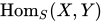
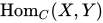
- (category theory, of a subcategory S of C) Including all morphisms. Formally: Such that for every pairs of objects (X, Y) in S, the hom-sets and are equal.
- Coordinate terms: embedding, replete, strictly full
- Total, entire.
-
1913, Joseph C[rosby] Lincoln, chapter I, in Mr. Pratt’s Patients, New York, N.Y.; London: D[aniel] Appleton and Company, →OCLC:
-
- Completely empowered, authorized or qualified (in some role); not limited.
- (informal) Having eaten to satisfaction, having a "full" stomach; replete.
- (informal, with "of") Replete, abounding with.
- (informal, of hands, chiefly in the plural) Carrying as much as possible.
- (of physical features) Plump, round.
- (of the moon) Having its entire face illuminated.
- (of clothing) Of a size that is ample, wide, or having ample folds or pleats to be comfortable.
- Having depth and body; rich.
-
a full singing voice
-
- (obsolete) Having the mind filled with ideas; stocked with knowledge; stored with information.
- Having the attention, thoughts, etc., absorbed in any matter, and the feelings more or less excited by it.
- Filled with emotions.
- (obsolete) Impregnated; made pregnant.
- (poker, postnominal) Said of the three cards of the same rank in a full house.
- (chiefly Australia) Drunk, intoxicated.
- 1925, United States House Committee on the Judiciary, Subcommittee No. 1, Charges Against William E. Baker, U.S. District Judge:
- Mr. Coniff: That is the only evidence you gave of his being intoxicated, that his hat was on the side? […] Mr. Coniff: That is the only indication you gave the committee when you were asked if the judge was full, that his hat was on the side of his head; is that right?
- 1925, United States House Committee on the Judiciary, Subcommittee No. 1, Charges Against William E. Baker, U.S. District Judge:
同意語
- (containing the maximum possible amount): abounding, brimful, bursting, chock-a-block, chock-full, full up, full to bursting, full to overflowing, jam full, jammed, jam-packed, laden, loaded, overflowing, packed, rammed, stuffed, pregnant
- (complete): complete, thorough
- (total): entire, total
- (satisfied, in relation to eating): glutted, gorged, sated, satiate, satiated, satisfied, stuffed
- (of a garment): baggy, big, large, loose, outsized, oversized, voluminous
- (drunk): See Thesaurus:drunk
反意語
派生語
- at full pelt
- at full stretch
- at full throttle
- at full tilt
- bankfull
- bowl full, bowl-full
- bung-full
- chock-a-block full
- chocked full
- chock full
- choke-full, choke full
- chuck full, chuck-full
- come full circle
- cram-full
- double-full
- few cards short of a full deck
- few cards shy of a full deck
- fouth
- full adder
- full agricultural tenancy
- full AI
- full and by
- full angle
- full artificial intelligence
- full as a boot
- full as a goog
- full as a tick
- full back
- fullback
- full-back
- full bar
- full bathroom
- full-beam.full beam
- full-bearded
- full bed
- full bikini wax
- full binary tree
- full bird
- full bird colonel
- full blast
- full-blood
- full blood
- fullblood
- full blood count
- full-blooded
- full-blown
- full blue
- full board
- full boat
- full-bodied
- full-bodied money
- full-body
- full-body day
- full-body scanner
- full body scanner
- full-bore, full bore
- full-born
- full-bosomed
- full-bound
- full breakfast
- full-breasted
- full-brother
- full bunger
- full-burn
- full-butt
- full butt
- full choke
- full circle
- full clew
- full colonel
- full color
- full combo
- full count
- full-course dinner
- full-course meal
- full-course yellow
- fullcourt
- full court press, full-court press
- full cousin
- full cream milk
- full debut
- full-deckism
- full deckism
- full disclosure
- full dive
- full dress
- full-dressed
- full dress uniform
- full-driven
- full duplex
- full eagle
- full eagle colonel
- full employment
- full English
- full English breakfast
- full-eyed
- full-face
- full-faced
- full faith and credit
- full-fat
- full fig
- full-figured
- full-fledged
- full-fleshed
- full fling
- full-flowing
- full-fortuned
- full forward
- full-frame
- full-fraught
- full-frontal
- full frontal
- full-frontal nudity
- full frontal nudity
- full functor
- full-grade
- full-grownness
- full-handed
- full-handedly
- full-handedness
- fullhead
- fullhearted
- full-hearted
- full-heartedly
- full-heartedness
- full-hot
- full house
- full immersion
- full infinitive
- full Irish
- full Irish breakfast
- fullish
- full join
- full-length
- full-line forcing
- full-looking
- fullmade
- full-made
- full marks
- full metal jacket
- full monty
- full moon
- full-mooned
- full-motion video
- full motion video
- full-mouth
- full-mouthed
- full name
- full nelson
- fullness
- full nester
- full nest syndrome
- full-nest syndrome
- full of
- full of beans
- full of bread
- full of crap
- full of hot air
- full of it
- full of oneself
- full of one's self
- full of piss and vinegar
- full of shit
- full-of-shitness
- full of the devil
- full of the joys of spring
- full on
- full-on
- full out
- full-out
- full outer join
- full-page
- full pelt
- full pint
- full-point
- full point
- full-pound
- full-pounder
- full-powered
- full price
- full process
- full-proof
- full rank
- full ratchet
- full retard
- full rhyme
- full ride
- full-rigged
- full sail
- full-scale
- fullscale
- full score
- full Scottish breakfast
- fullscreen
- full screen
- full screw
- full sea
- full send
- full service
- full-service
- fullset
- fullsib
- full-sibling
- full sibling
- full-sister
- full-size
- fullsome (often a misspelling)
- full-souled
- full-spectrum superiority
- full spectrum superiority
- full speed ahead
- full stack
- full-stack
- full-stacker
- fullstanding
- full steam
- full steam ahead
- full stop
- full-stop landing
- full-stretch
- full stroke seek time
- full-summed
- full swap
- full take
- full term
- full-throated
- full-throatedly
- full-throttle
- full throttle
- full tide
- full tilt
- full tilt boogie
- full-tilt boogie
- full time
- full-time
- full-time equivalent
- full-timer
- full-tongued
- full to overflowing
- full toss
- full to the gills
- full verb
- full vowel
- full whack
- full-width
- fullwidth
- fullwise
- full word
- fully
- full-zip
- glass-half-full
- half full
- handful
- have full hands
- have one's hands full
- hawse-full
- ideographic full stop
- I'm full
- in full aspect
- in full chase
- in full course
- in full cry
- in full effect
- in full feather
- in full fig
- in full flow
- in full force
- in full form
- in full gear
- in full swing
- in full view
- know full well
- last full measure
- nervous as a long-tailed cat in a room full of rocking chairs
- nonfull
- nut full house
- on a full stomach
- one brick short of a full load
- one card short of a full deck
- one card shy of a full deck
- overfull
- play full
- play with a full deck
- Quiverfull
- rap-full
- see the glass half-full
- the full nine yards
- the full quid
- the full shilling
- the full ticket
- the wheel has come full circle
- topfull
- to the full
- triple-full
- underfull
- unfull
副詞
full (not comparable)
- (archaic) Fully; quite; very; thoroughly; completely; exactly; entirely.
-
1910, Emerson Hough, chapter I, in The Purchase Price: Or The Cause of Compromise, Indianapolis, Ind.: The Bobbs-Merrill Company, →OCLC:
派生語
語源 2
From 中期英語 fulle, fylle, fille, from 古期英語 fyllu, fyllo (“fullness, fill, plenty”), from Proto-Germanic *fullį̄, *fulnō (“fullness, filling, overflow”), from Proto-Indo-European *plūno-, *plno- (“full”), from *pelh₁-, *pleh₁- (“to fill; full”). Cognate with German Fülle (“fullness, fill”), Icelandic fylli (“fulness, fill”). More at fill.
名詞
full (plural fulls)
- Utmost measure or extent; highest state or degree; the state, position, or moment of fullness; fill.
- (of the moon) The phase of the moon when its entire face is illuminated, full moon.
- a. 1622, Francis Bacon, Natural History, in The works of Francis Bacon, 1765, page 322
- a. 1656, Joseph Hall, Josiah Pratt (editor), Works, Volume VII: Practical Works, Revised edition, 1808 page 219,
- (gymnastics) A flip involving a complete turn in midair.
- (freestyle skiing) An aerialist maneuver consisting of a backflip in conjunction and simultaneous with a complete twist.
派生語
- at full, at the full
- in full
- to the full
- double full
- double full-full
- full-double full
- full-double full-full
- full-full
- full-full-full
- lay-double full-full
- lay-full
- lay-full-full
動詞
full (third-person singular simple present fulls, present participle fulling, simple past and past participle fulled)
語源 3
From 中期英語 fullen, fulwen (“to baptise”), from 古期英語 fullian, fulwian (“to baptise”), from full- + *wīhan (later *wēon (“to make holy”)). Compare 古期英語 fulluht, fulwiht (“baptism”).
動詞
full (third-person singular simple present fulls, present participle fulling, simple past and past participle fulled)
- (transitive) To baptise.
-
1610 October, John Foxe, “An Old Ancient Writing Intituled, The Praier and Complaint of the Ploughman”, in Actes and Monuments of Matters Most Speciall and Memorable, Happening in the Church, with an Vniuersall Historie of the Same. […], 6th edition, volume I, London: […] [Humphrey Lownes] for the Company of Stationers, →OCLC, book V, page 373, column 2:
-
派生語
語源 4
From 中期英語 fullen (“to full”), from Anglo-Norman fuller, fuler, Middle French foller, fouler, from Old French foler, fouler (“to tread, stamp, full”), from Medieval Latin fullāre, from Latin fullō (“a fuller”). Compare 古期英語 fullian (“to full”).
動詞
full (third-person singular simple present fulls, present participle fulling, simple past and past participle fulled)
別の表記
語源 1
From Proto-West Germanic *full, from Proto-Germanic *fullaz, from Proto-Indo-European *pl̥h₁nós (“full”), from *pleh₁- (“to fill”).
形容詞
full
語形変化
語源 2
From Proto-Germanic *fullą (“vessel”), from Proto-Indo-European *pēl(w)- (“a kind of vessel”). Akin to Old Saxon full (“beaker”), Old Norse full (“beaker, toast”).
語形変化
| singular | plural | |
|---|---|---|
| nominative | full | full |
| accusative | full | full |
| genitive | fulles | fulla |
| dative | fulle | fullum |
語源 1
語源 2
語源 3
full-
語源
From Proto-West Germanic *full-, *fulla- (“fully, completely”), related to 古期英語 full (“full, complete”).
派生語
Weblio例文辞書
動詞の活用形:
|


- Copyright (c) 1995-2026 Kenkyusha Co., Ltd. All rights reserved.
- Copyright © Benesse Holdings, Inc. All rights reserved.
- © 2000 - 2026 Hyper Dictionary, All rights reserved

- Copyright (c) 1995-2026 Kenkyusha Co., Ltd. All rights reserved.

- Copyright (C) 1994- Nichigai Associates, Inc., All rights reserved.

- All Rights Reserved, Copyright © Japan Science and Technology Agency
- 北里大学医療衛生学部 医療情報学研究室編集 医学用語集
- ※この記事は「北里大学医療衛生学部 医療情報学研究室」ホームページ内の「医学用語集」(2001.06.10. 改訂)の情報を転載しております。

- Copyright (C) 2026 ライフサイエンス辞書プロジェクト
- 日本語ワードネット1.1版 (C) 情報通信研究機構, 2009-2010 License All rights reserved.
WordNet 3.0 Copyright 2006 by Princeton University. All rights reserved. License

- Copyright(C)2002-2026 National Institute of Information and Communications Technology. All Rights Reserved.

- Copyright (C) 1994- Nichigai Associates, Inc., All rights reserved.
「斎藤和英大辞典」斎藤秀三郎著、日外アソシエーツ辞書編集部編
- Wiktionary
- Text is available under Creative Commons Attribution-ShareAlike (CC-BY-SA) and/or GNU Free Documentation License (GFDL).
Weblio英和・和英辞典に掲載されている「Wiktionary英語版」の記事は、Wiktionaryのfull (改訂履歴)、full- (改訂履歴)の記事を複製、再配布したものにあたり、Creative Commons Attribution-ShareAlike (CC-BY-SA)もしくはGNU Free Documentation Licenseというライセンスの下で提供されています。
- CMUdict
- CMUdict is Copyright (C) 1993-2008 by Carnegie Mellon University.
