

研究社 新英和中辞典

F.O.R.
f.o.r., F.O.R.
for
for /(弱形) fɚ|fə; (強形) fˈɔɚ|fˈɔː/

1 [利益・影響を表わして] …のために[の]; …にとって.
2 a [敬意を表わして] …を記念して,…のために.
b [模倣を表わして] 《主に米国で用いられる》 …にちなんで,…の名を取って (《主に英国で用いられる》 after).
3 [受け取り予定者・宛先を表わして] …に与えるために[の], …あての.
4 [目的地・行き先を表わして] …へ向かって,…へ行くために[の]; …に入場するために[の].
5 [目的・意向を表わして] …のために,…を目的として; …をめざして,…になる[をする]つもりで.
6 [獲得・追求・期待の対象を表わして] …を得るために[の], …を(求めて).
7 [準備・保全・防止を表わして] …に備えるために[の], …を保つ[直す]ために[の].
8 [用途・指定・適否を表わして] …向きに[の], …用に[の]; …に適した.
9 [指定の日時・祝日を表わして] 〈何日・何時〉に[の]; …の時に[の]; …を祝うために.
10 [時間・距離を表わして] …の間(ずっと); (予定期間として)…の間(は) 《★【用法】 この意の for はしばしば 《口語》 では略される》.
11 [数量・金額を表わして] …分だけ(の), …まで(の).
12 [代理・代用を表わして] …の代わりに[の], …のために.
13 a [表示を表わして] …を表わして.
b [代表を表わして] …を代表して.
14 [交換・代償を表わして] …と引き替えに; 〈商品など〉に対して; …の金額[値段]で.
15 [報償・返報を表わして] 〈好意・成果など〉に対して,…の返報として.
16 [賛成・支持・味方を表わして] …を支持して[した], …のために,…に味方して (⇔against).
17 a [感情・趣味・適性などの対象を表わして] …に対して[する], …を理解する.
b [cause,reason,ground,motive,foundation などの後で用いて] …に対しての,…すべき.
18 [原因・理由を表わして]
a …の理由で,…のため.
b [通例 the+比較級の後で] …の結果(として), …のせいで.
a [each,every や数詞の前で] …に対して.
b [前後に同一名詞を用いて] (同じ資格・重要性・価値などの)…と…を比べて(みた場合).
1 [不定詞の主語関係を示して] …が(…する).
2 [通例 it is for a person to do の形で] (…するのは)…にふさわしい,…がすべきことである.
前置詞
A
- 用例
-
- 用例
-
- 用例
-
- 用例
-
- What did you do that for? 何のためにそんなことをしたのか.
- He volunteered for the task. 彼はその仕事に志願した.
- 用例
-
- 用例
-
- 用例
-
- 用例
-
- 用例
-
- for the last ten years この 10 年間.
- for all time 永久に.
- for days (and days) on end 来る日も来る日も.
- walk (for) three miles 3マイル歩く.
- We stayed there (for) three weeks. 我々はそこに 3 週間滞在した.
- The snowy weather lasted (for) the whole time we were there. そこにいる間中雪の日が続いた.
- I haven't spoken to her for two months. 彼女とは 2 か月話をしていない.
- For miles and miles there was nothing but sand. 何マイルもの間砂ばかりだった.
- He didn't work for (very) long. 彼は(あまり)長くは働かなかった 《じきにやめた》.
- They went down to the sea for a [the] day. 彼らは日帰りで海に行った.
- The TV station stopped broadcasting for the day. テレビ局は一日の放送を終えた.
- That's all for today. きょうはこれで終わり.
- 用例
-
- a substitute for butter バターの代用品.
- 用例
-
- the Member of Parliament for Liverpool リバプール選出の議員.
- 用例
-
- 用例
-
- 用例
-
- 用例
-
- shout for joy うれしくて大声を出す.
- a city known for its beauty 美しいことで知られた都市.
- I can't see anything for the fog. 霧で何も見えない.
- She could hardly sleep that night for thinking of George. その夜彼女はジョージのことを考えてほとんど眠れなかった.
- I was angry with him for being late. 遅れてきたので彼に腹が立った.
- He was rewarded for saving the girl's life. 彼はその少女を救ったためほうびをもらった.
- 用例
-
- ⇒be the BETTER1 for…, be the worse for WEAR1 名詞【成句】.
- 用例
-
- for that matter そのことで言えば.
- 用例
-
- 用例
-
- 用例
-
- 用例
-
- Dollar for dollar, you get more value at this store than at the other one. 同じ 1 ドルを使って, 向こうよりこっちの店のほうがよけい買い物ができる.
- ⇒MAN for man, POINT for point, WORD for word 【成句】.
B
- 用例
-
- It's necessary for travelers to carry a passport. 旅行者はパスポートを携帯することが必要だ 《★【変換】 It's necessary that travelers (should) carry a passport. と書き換え可能》.
- His idea is for us to travel in two cars. 彼の考えは我々が 2 台の車に乗っていこうというのである 《★【変換】 His idea is that we (should) go in two cars. と書き換え可能》.
- It's time for me to go. もう私の行く時だ 《★【変換】 It's time I went. と書き換え可能》.
- I stood aside for him to enter. 彼が入れるようにわきに寄った 《★【変換】 I stood aside so that he might enter. と書き換え可能》.
- For a girl to talk to her mother like that! 女の子が母親にあんなものの言い方をするなんて!
- I'm waiting for her to come. 私は彼女が来るのを待っているところだ.
- 語法
-
![[N16-A26B]](https://cdn.weblio.jp/e7/wbr/CHUJITEN/N16-A26B_F-000000_B-FFFFFF.png)
- às for…
- be fór it
- be ín for…
- bùt for…
- excèpt for …
- for áll…
- for áll [《古・文語》 áught] …cáre
- for áll [《古・文語》 áught] …knów
- for áll the wórld
- for déar lífe
- for áll the wórld lìke [as ìf]…
- for bétter (or) for wórse
- for éver (and éver)
- for féar of…
- for góod (and áll)
- fòr it
- for one's lífe
- for one's pàrt
- for óne
- for óne thìng
- for onesélf
- for the lífe of one
- If it were nót [had nót been] for…
- Thàt's
![[W16-A34D]](https://cdn.weblio.jp/e7/wbr/CHUJITEN/W16-A34D_F-000000_B-FFFFFF.png) for you.
for you. - Thát's what…is fòr.
- Thère'sfor you.
接続詞
【語源】
for.
for‐
調べた例文を記録して、効率よく覚えましょう
Weblio会員無料で登録できます
 履歴機能
過去に調べた単語を確認できる
履歴機能
過去に調べた単語を確認できる
 語彙力診断
診断回数が4回に増加
語彙力診断
診断回数が4回に増加
 マイ単語帳
便利な学習機能付き
マイ単語帳
便利な学習機能付き
 マイ例文帳
文章で意味を理解できる
マイ例文帳
文章で意味を理解できる
Eゲイト英和辞典

for
音節for発音記号・読み方((弱))fər,((強))fɔ́ːr
覚え方…に向かって
前置詞
接続詞
覚え方…に向かって
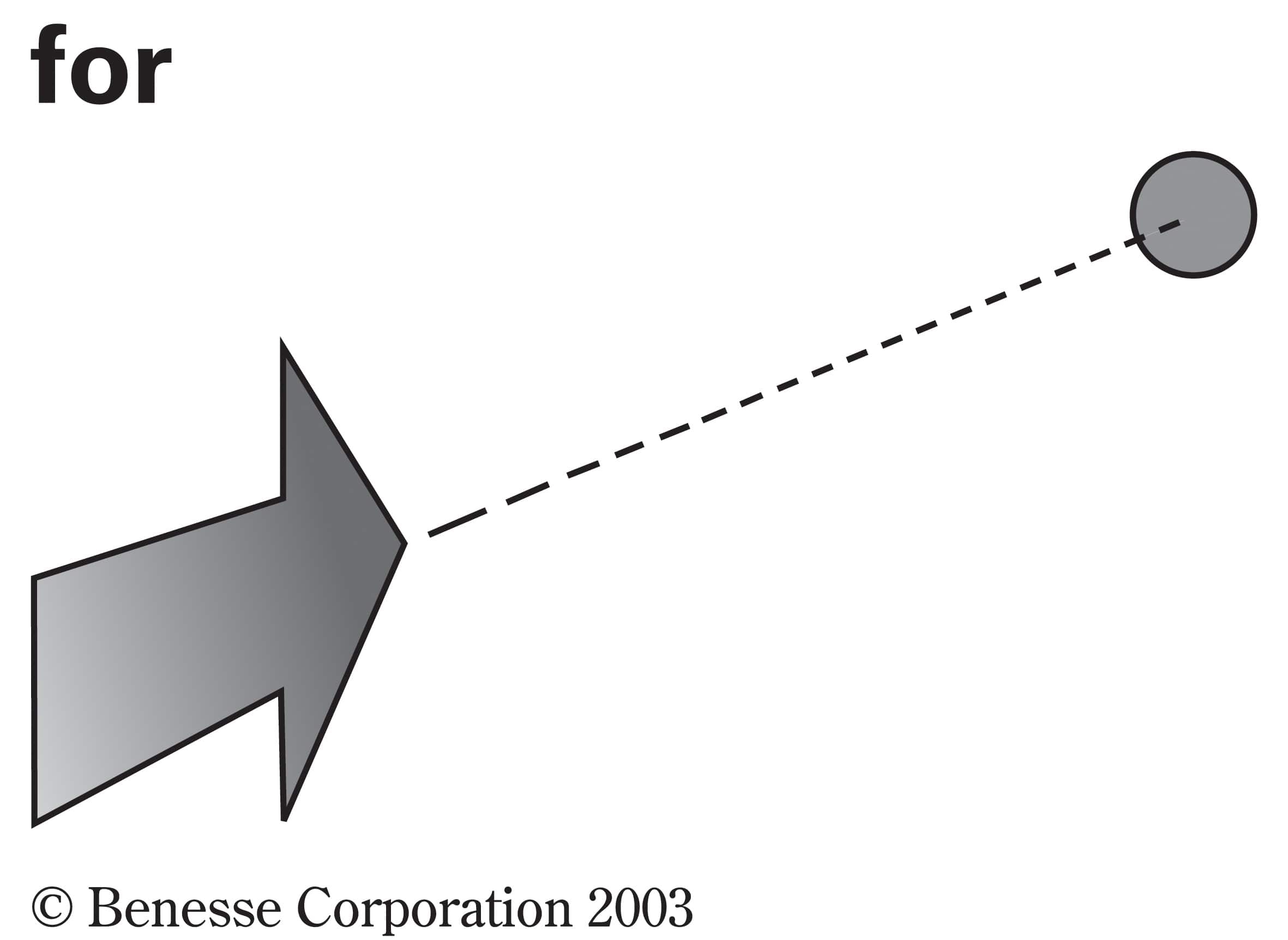 |
向かう方向を強調し,対象を心理的に指差している |
Ⅰ目標の対象を指して前置詞
├〔方向〕…に向かって;…にあてて▷1
├〔目的〕…の目的で▷2
├〔利益〕…のために▷3
├〔準備〕…に備えて▷4
├〔支持〕…に賛成して▷5
└〔特定の日時〕…に▷6
Ⅱ時間の流れを指して前置詞
└〔期間〕…の間▷8
Ⅲ関係の対象を指して前置詞
├〔代理〕…の代わりに▷9
├〔交換〕…と引き換えに▷10
├〔適合〕…に適した▷11
└〔割合〕…に対して▷12
Ⅳ判断の観点となる対象を指して前置詞
├〔基準〕…にしては▷13
├〔判断の対象〕…にとって▷14
├〔不定詞の意味上の主語〕…が▷15
├〔理由〕…の理由で▷16
└〔関連〕…については▷17
├〔方向〕…に向かって;…にあてて▷1
├〔目的〕…の目的で▷2
├〔利益〕…のために▷3
├〔準備〕…に備えて▷4
├〔支持〕…に賛成して▷5
└〔特定の日時〕…に▷6
Ⅱ時間の流れを指して前置詞
└〔期間〕…の間▷8
Ⅲ関係の対象を指して前置詞
├〔代理〕…の代わりに▷9
├〔交換〕…と引き換えに▷10
├〔適合〕…に適した▷11
└〔割合〕…に対して▷12
Ⅳ判断の観点となる対象を指して前置詞
├〔基準〕…にしては▷13
├〔判断の対象〕…にとって▷14
├〔不定詞の意味上の主語〕…が▷15
├〔理由〕…の理由で▷16
└〔関連〕…については▷17
前置詞
Ⅰ目標の対象を指して
1〔方向〕…に向かって,(乗り物が)…行きで;(電話・手紙・贈り物などが)…にあてて,向けて
2〔目的〕…の目的で,…を得るために,…を求めて
3〔利益〕…のために
4〔準備〕…に備えて,…に対して
5〔支持〕…に賛成して,…を支持して(←→against)
6〔特定の日時〕…に;…を祝って
7((米))…の名にちなんで
Ⅱ時間の流れを指して
8〔期間〕…の間
Ⅲ関係の対象を指して
9〔代理〕…の代わりに,…のために;…を代表して;…を表して
10〔交換〕…と引き換えに,…の代わりに;(品物・好意など)に対して
11〔適合〕…に適した,…に向いた;…に(合わせて),…に対する
12〔割合〕…に対して,につき
Ⅳ判断の観点となる対象を指して
13〔基準〕…にしては,…するには;…に対して;…としては
14〔判断の対象〕…にとって
15〔不定詞の意味上の主語〕((for A to do))A(人)が…することは
16〔理由・原因〕…の理由で,…のために,…のせいで
17〔関連〕…については,…としては
1〔方向〕…に向かって,(乗り物が)…行きで;(電話・手紙・贈り物などが)…にあてて,向けて
2〔目的〕…の目的で,…を得るために,…を求めて
|
3〔利益〕…のために
4〔準備〕…に備えて,…に対して
5〔支持〕…に賛成して,…を支持して(←→against)
6〔特定の日時〕…に;…を祝って
7((米))…の名にちなんで
Ⅱ時間の流れを指して
8〔期間〕…の間
Ⅲ関係の対象を指して
9〔代理〕…の代わりに,…のために;…を代表して;…を表して
10〔交換〕…と引き換えに,…の代わりに;(品物・好意など)に対して
11〔適合〕…に適した,…に向いた;…に(合わせて),…に対する
12〔割合〕…に対して,につき
Ⅳ判断の観点となる対象を指して
13〔基準〕…にしては,…するには;…に対して;…としては
14〔判断の対象〕…にとって
15〔不定詞の意味上の主語〕((for A to do))A(人)が…することは
16〔理由・原因〕…の理由で,…のために,…のせいで
17〔関連〕…については,…としては
接続詞
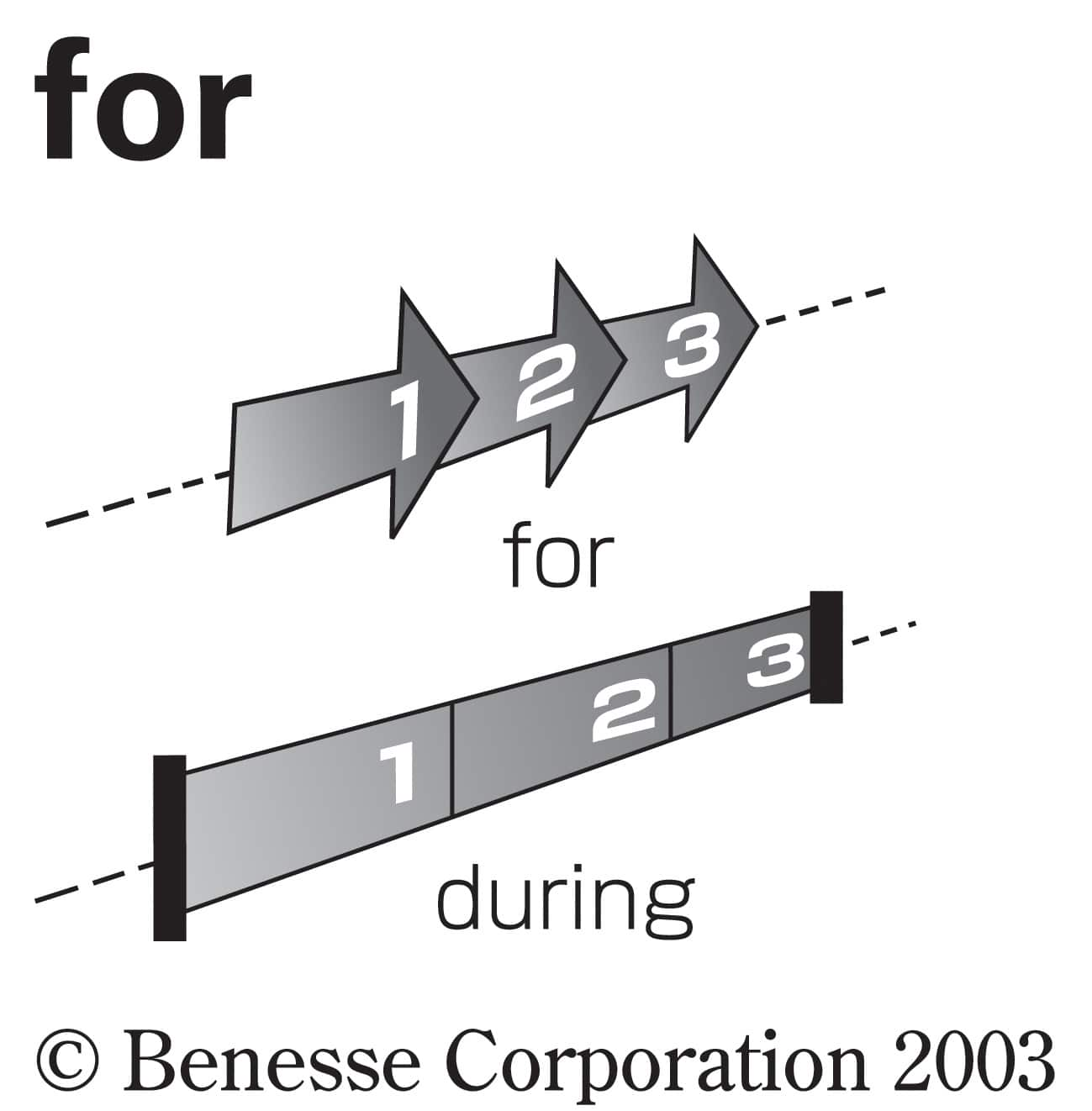
語法時間の流れを表すfor 時間は流れとして把握され,その流れに沿って動作や行為も進展すると考えられる.for three yearsは「3年という時間の流れ」を指し,I'll study French for the next three years.「これから3年間フランス語を勉強します」には「1年目→2年目→3年目」と時間が流れていく中でフランス語の勉強が進展するという意味が込められている |
ネットワークforとduring 流れている時間ではなく,区切られたある特定の期間を表すような場合にはduringを用いるのがふつう.a period of three yearsは(不特定の)3年という時間の流れを表すためにforで受けることができるが,the period of three yearsは「その3年間」と期間を特定しているためduringを用いる |
 |
for.
Weblio実用英語辞典

for
「for」は「~のために」「~向けに」「~に対して」「~の間に」「〜については」「〜に賛成して」といった意味を持つ前置詞や、「なぜなら」「というのも」という意味を持つ接続詞である。
前置詞:~のために、~向けに、~に対して、~の間に、〜については、〜に賛成して
接続詞:なぜなら、というのも
1. I bought a gift for you.(あなたのためにギフトを買った。)
2. This book is for beginners.(この本は初心者向けだ。)
3. She spoke for all of us.(彼女は私たち全員に代わって話した。)
4. He has been working for three hours.(彼は3時間働いている。)
5. I am for the proposal.(私はその提案に賛成だ。)
1. I'm happy, for I have passed the exam.(試験に合格したので、私は幸せだ。)
2. He must be tired, for he has been working all day.(彼は一日中働いていたので、疲れているに違いない。)
3. She didn't come, for she was ill.(彼女は病気だったので、来なかった。)
4. We need to leave now, for the train leaves in ten minutes.(列車が10分後に出発するので、今出発する必要がある。)
5. They were all smiling, for they had heard the good news.(彼らはみな、良いニュースを聞いていたので、笑顔だった。)
「for」とは・「for」の意味
for前置詞:~のために、~向けに、~に対して、~の間に、〜については、〜に賛成して
接続詞:なぜなら、というのも
forの用法
前置詞
~のために、~向けに、~に対して、~の間に、〜については、〜に賛成して「for」が前置詞として使われる場合、目的、受益者、方向、期間、意見の支持などを示す。具体的な例を以下に示す。
・例文1. I bought a gift for you.(あなたのためにギフトを買った。)
2. This book is for beginners.(この本は初心者向けだ。)
3. She spoke for all of us.(彼女は私たち全員に代わって話した。)
4. He has been working for three hours.(彼は3時間働いている。)
5. I am for the proposal.(私はその提案に賛成だ。)
接続詞
なぜなら、というのも「for」が接続詞として使われる場合、理由や原因を説明する際に用いられる。具体的な例を以下に示す。
・例文1. I'm happy, for I have passed the exam.(試験に合格したので、私は幸せだ。)
2. He must be tired, for he has been working all day.(彼は一日中働いていたので、疲れているに違いない。)
3. She didn't come, for she was ill.(彼女は病気だったので、来なかった。)
4. We need to leave now, for the train leaves in ten minutes.(列車が10分後に出発するので、今出発する必要がある。)
5. They were all smiling, for they had heard the good news.(彼らはみな、良いニュースを聞いていたので、笑顔だった。)
ハイパー英語辞書

for
前置詞
- 用例
| 印欧語根 | ||
|---|---|---|
| per | 非常に広い意味を持つ印欧語根で、基本的には「前に」「…を経て」を表す前置詞の意味を持つ。その他にin front of, before, early, first, chief, toward, against, near, at, aroundのような広い意味を表す。 主な派生語には、first, from, before, forth, paradise, per-で始まる多くの語(percentなど)、接頭辞pre-を持つ語(preludeなど)、pri-で始まる多くの語(princeなど)、接頭辞pro-を持つ語(propertyなど)などがある。 | |
for-
| 印欧語根 | ||
|---|---|---|
| per | 非常に広い意味を持つ印欧語根で、基本的には「前に」「…を経て」を表す前置詞の意味を持つ。その他にin front of, before, early, first, chief, toward, against, near, at, aroundのような広い意味を表す。 主な派生語には、first, from, before, forth, paradise, per-で始まる多くの語(percentなど)、接頭辞pre-を持つ語(preludeなど)、pri-で始まる多くの語(princeなど)、接頭辞pro-を持つ語(propertyなど)などがある。 | |
コンピューター用語辞典

遺伝子名称シソーラス

FOR
| human | 遺伝子名 | FOR |
| 同義語(エイリアス) | WWOX; WW domain containing oxidoreductase; Fragile site FRA16D oxidoreductase; WWOX v8; WOX1; D16S432E; FRA16D; HHCMA56; WW domain-containing oxidoreductase; PRO0128 | |
| SWISS-PROTのID | SWISS-PROT:Q9NZC7 | |
| EntrezGeneのID | EntrezGene:51741 | |
| その他のDBのID | HGNC:12799 |
本文中に表示されているデータベースの説明

Weblio英和対訳辞書
Wiktionary英語版
出典:Wiktionary
for-
出典:『Wiktionary』 (2026/07/05 03:55 UTC 版)
語源 1
From 中期英語 for-, vor-, ver-, from 古期英語 for-, fer-, fær-, fyr- (“far, away, completely”, prefix), from the merger of Proto-Germanic *fra- ("away, away from"; see fro, from) and Proto-Germanic *fur-, *far- (“through, completely, fully”), from Proto-Indo-European *pro-, *per-, *pr-. Cognate with Scots for-, West Frisian fer-, for-, Dutch ver-, German ver-, Swedish för-, Danish for-, Norwegian for-, Gothic 𐍆𐍂𐌰- (fra-), Latin pro-. More at for.
接頭辞
for-
- (no longer productive) Forth: prefixed to verbs to indicate a direction of 'away', 'off', 'forth'.
- (no longer productive) Exhausting: prefixed to verbs with the sense of wearing or exhausting oneself.
- (no longer productive) Destructively: prefixed to verbs with the sense of destruction or pain.
- (no longer productive) Wrongly: prefixed to verbs with the sense of wrongly, amorally.
- (no longer productive) Neglectfully: prefixed to verbs with the sense of abstaining from or neglecting.
- (no longer productive) Very: intensifying adjectives.
- (no longer productive) Making: prefixed to verbs to indicate the subject takes the character of the verb.
- (no longer productive) Excessively: prefixed to verbs with the sense of doing so in excessive or overwhelm.
- (no longer productive) Excluding: prefixed to verbs to give the sense of prohibition or exclusion.
- (no longer productive) Intensively
- (no longer productive) Thoroughly: prefixed to verbs with the sense of thoroughly, all over.
派生語
forban
forbar
forbathe
forbeat
forbite
forblack
forbleed
forburst
forbuy
forbyland
forcarve
forcover
forcut
fordede
fordim
fordone
fordote
fordread
fordrench
fordull
forfaint
forfight
forflutter
forbuyer
forcleave
forhush
forshorten
forswarted
forswearer
forwasted
forgab
forgnaw
forhale
forhang
forhard
forharden
forhare
forhele
forhill
forirk
forlat
forlay
forleave
forlend
forlie
forlighten
forloppin
fornigh
forold
forpine
forridden
forsaid
forscald
forsench
forshake
forshut
forsing
forslack
forsloth
forslow
forslug
forsmite
forspare
forswart
forsweal
forswelt
forswing
forswunk
fortatter
forteach
fortear
fortravel
forwalk
forwall
forwax
forwean
forweary
forwelk
forwither
forworship
- forbreak
- forcleave
- fordo
- foretossed
- forgab
- forhang
- forlornness
- forseethe
- forthink
- forwall
- forwither
- forworth
- forblack
- fordry
- forfaint
- forhungered
- forold
- forridden
- forspent
- forswollen
- forweary
- fordread
- forlay
- forpass

語源 2
From 古期英語 for-, which is identical with the preposition "for". In "古期英語 and 中期英語 it occurs frequently as a variant of fore- prefix, with the senses ‘before’, ‘in front’, ‘on behalf of’, etc.; cf. 古期英語 for-, forecuman to come before, 中期英語 forganger and foreganger n."
接頭辞
for-
語源 3
"Occurring only in words adopted from French, as forcatch v., forfeit n., forprise n., represents Old French for-, fors-, identical with fors adv. (modern French hors) outside, out."
別の表記
- fore-
接頭辞
for-
参照
- ^ Oxford English Dictionary, s.v. “for- (prefix2),” March 2024, https://doi.org/10.1093/OED/1183476270.
- ↑ Oxford English Dictionary, s.v. “for- (prefix3),” September 2023, https://doi.org/10.1093/OED/8923913950.
参考
- fore-
発音
- IPA: /for/
接頭辞
for-
- wrongly, away from, astray, abstention, prohibition, perversion, destruction (verbal prefix)
- used to create intensified adjectives and verbs from other adjectives and verbs, with the sense of completely or fully; compare Modern English use of up
- forblāwan ― to blow up, inflate
- forbrecan ― to break up, break into pieces
- forstoppian ― to stop up, block, occlude
- forweoren ― decayed, decrepit
- very
- forlȳtel ― very little
- foreald ― very old
使用する際の注意点
- This prefix was almost always unstressed, in both nouns and verbs.
派生語
aforfeorsian
forberan
forbregdan
forcierran
forclysan
forcuman
forcyrran
forcyþan
fordrencan
fordyttan
fretan
forfleon
forfon
forslæwan
forspennan
forgieldan
forgyltan
forhatan
forheawan
forhogian
forhweorfan
forleosan
formeltan
formieltan
forneah
forniman
forpæran
forrotian
forscamian
forscieppan
forscrifan
forscrincan
forscyldig
forscyldigian
forseoþan
forsiþ
forspanan
forspiercan
forspillan
forsprecan
forstandan
forstelan
forswælan
forsweltan
forsweorcan
forswiþan
fortredan
forþencan
forþeostrian
forþiestrian
forþingian
forþryccan
forþyrrian
forwiernan
forwyrd
forwyrhta
語源
From 古期英語 for-, from Proto-West Germanic *fra-, from Proto-Germanic *fra-, from Proto-Indo-European *pro-.
The 古期英語 prefix was reinforced by Proto-West Germanic *furi-, from Proto-Germanic *furi-; In 中期英語, this prefix is further reinforced by Old French for-, from Latin foris.
接頭辞
for-
派生語
forbannen
forbarren
forbeaten
forbeoden
forbinden
forblowen
forbrusen
forclemmen
forcoveren
forcrempen
fordemen
fordwynen
forglopned
forgreithen
forgreithing
forholden
forkerven
forleven
forliven
fornimen
forarnen
forsenden
forsethen
forshrinken
forslyngren
forthristen
forwerpen
forwird
foryiven
参照
- “for-, pref.(1).”, in MED Online, Ann Arbor, Mich.: University of Michigan, 2007.
- “for-, pref.(2).”, in MED Online, Ann Arbor, Mich.: University of Michigan, 2007.
FOR
固有名詞
FOR
Weblio例文辞書


- Copyright (c) 1995-2026 Kenkyusha Co., Ltd. All rights reserved.
- Copyright © Benesse Holdings, Inc. All rights reserved.
- © 2000 - 2026 Hyper Dictionary, All rights reserved
- Copyright (C) 1994- Nichigai Associates, Inc., All rights reserved.

- Copyright (C) 1994- Nichigai Associates, Inc., All rights reserved.

- All Rights Reserved, Copyright © Japan Science and Technology Agency

- Copyright © 2026 CJKI. All Rights Reserved
- DBCLS Home Page by DBCLS is licensed under a Creative Commons 表示 2.1 日本 License.

- Copyright (C) 1994- Nichigai Associates, Inc., All rights reserved.
「斎藤和英大辞典」斎藤秀三郎著、日外アソシエーツ辞書編集部編
- Wiktionary
- Text is available under Creative Commons Attribution-ShareAlike (CC-BY-SA) and/or GNU Free Documentation License (GFDL).
Weblio英和・和英辞典に掲載されている「Wiktionary英語版」の記事は、Wiktionaryのfor- (改訂履歴)、FOR (改訂履歴)の記事を複製、再配布したものにあたり、Creative Commons Attribution-ShareAlike (CC-BY-SA)もしくはGNU Free Documentation Licenseというライセンスの下で提供されています。
- CMUdict
- CMUdict is Copyright (C) 1993-2008 by Carnegie Mellon University.
