

研究社 新英和中辞典

fall
fall /fˈɔːl/

1 (重力によって無意図的に)落ちる 《★【用法】 この形の他動詞は通例ないので,他動詞的に用いるには使役動詞とともに用いて表現する》: 〔動(+副(句))〕
a 〈もの・人が〉落ちる,落下する.
b 〈雨・雪などが〉降る; 〈霜が〉降りる.
c 〈ものが〉とれて落ちる; 〈葉・花などが〉散る; 〈髪などが〉抜け落ちる.
2 a 〔動詞(+副詞(句))〕(特に,突然不本意に)倒れる,転ぶ; (自分から)倒れる,平伏する.
b 〔(+down)+補語〕〈…の状態で〉倒れる.
c 〔動詞(+副詞(句))〕(傷ついて[撃たれて])倒れる; (戦闘などで)死ぬ.
d 〔(+down)+補語〕倒れて〈…の状態に〉なる.
e 〔動詞(+副詞(句))〕〈建物・橋などが〉くずれ落ちる,倒壊する.
f 〔動詞(+前置詞+(代)名詞)〕〈要塞(ようさい)・都市などが〉〔敵などの手に〕落ちる,陥落する 〔to,under〕.
g 〈国家・政府などが〉倒れる,滅びる.
h 〔動詞(+from+(代)名詞)〕〔高い地位から〕落ちる,失脚[転落]する,声望を失う.
3 〔+前置詞+(代)名詞〕
a 〈髪・衣服などが〉〔…に〕垂れ下がる 〔over,down〕; 〔…まで〕垂れ下がる 〔to〕; 〔…から〕垂れ下がる 〔from〕.
b 〈土地などが〉〔…に〕傾斜する,下がっている 〔to,toward〕.
4 a 〔動詞(+前置詞+(代)名詞)〕〈計器(の水銀)・温度・圧力などが〉〔…に〕下がる 〔to,below〕.
b 〔動詞(+前置詞+(代)名詞)〕〈川が〉〔…に〕水位を下げる; 〈川の水位が〉〔…に〕下がる 〔to,below〕.
c 〈洪水などが〉退く; 〈潮が〉ひく.
d 〈風などが〉衰える,静まる; 〈火が〉下火になる.
e 〔動詞(+to+(代)名詞)〕〈声などが〉〔…に〕低くなる.
f 〈値段・需要などが〉下がる,減る.
g 〈人気などが〉落ちる; 〈人・ものが〉評価[値]が下がる.
5 a 〈眼・視線が〉下を向く.
b 〈顔が〉気落ちした[がっかりした]表情になる,曇る; 〈気力が〉落ちる; 〈気分が〉沈む.
6 〔動詞(+from+(代)名詞)〕〈音声・言葉が〉〔口から〕漏れ出る.
7 a 〔動詞(+前置詞+(代)名詞)〕(上から降りてくるように)〈暗やみ・静けさなどが〉〔…に〕やってくる 〔on,upon,over〕.
b 〔+前置詞+(代)名詞〕〈災い・復讐などが〉〔…に〕降りかかる 〔on,upon,over〕.
8 〔+前置詞+(代)名詞〕
a 〈矢・光などが〉〔…に〕当たる 〔on,upon〕.
b 〈目・視線などが〉〔…に〕(ふと)向けられる 〔on,upon〕.
9 〔+前置詞+(代)名詞〕
a 〈負担・義務・仕事などが〉〔…に〕ふりかかる,〔…の〕肩にかかってくる 〔on,upon,to〕.
b 〈くじなどが〉〔人に〕当たる 〔on,upon〕.
10 a 〈時節などが〉来る.
b 〔+on+(代)名詞〕〔ある日に〕当たる.
c 〔+on+(代)名詞〕〔不運などに〕出くわす.
d (偶然に)到来する.
e 〔+to+(代)名詞〕〈遺産などが〉たまたま〔…の〕ものとなる.
f 〔+on+(代)名詞〕〈アクセントが〉〔…に〕ある.
11 〔+前置詞+(代)名詞〕
a 〔ある立場・状態に〕置かれる; 〔ある範囲に〕入る 〔into,under,within〕.
b 偶然〔ある集団の〕中に入る; 〔盗賊などに〕出会う,取り囲まれる 〔among〕.
12 誘惑に屈する,堕落する; 〈女が〉純潔を失う.
1 〔+補語〕〈…の状態・関係に〉なる,陥る.
2 〔+前置詞+(代)名詞〕
a 〔好ましくない状態に〕落ち込む,陥る 〔into〕.
b 〔…から離れた〕状態になる; 〔習慣などから〕脱け出る 〔out of〕.
3 〔+前置詞+(代)名詞〕〔…を〕始める 〔to,into〕.
1 可算名詞
a 落下,降下,墜落; 落下物.
b [通例単数形で] 落下距離,落差 〔of〕.
2 可算名詞
a 〔雨などの〕降下,降雨,降雪 〔of〕.
b [通例単数形で] 降雨[降雪]量 〔of〕.
3 a 可算名詞 転ぶこと,転倒.
b 可算名詞 (建物などの)倒壊.
c [the fall] 没落,衰亡,瓦解; 陥落 〔of〕.
d [単数形で] 転落; 堕落.
e [the Fall (of Man) で] 人間の堕落 《Adam と Eve の原罪; cf. original sin》.
4 可算名詞 [時に 不可算名詞] 〔物価・温度などの〕低下,下落,減少 〔in,of〕.
5 [複数形で] 滝 《★【用法】 固有名詞の場合は通例単数扱い》.
6 可算名詞 傾斜,下り坂,勾配.
7 a 不可算名詞 垂れ下がること,垂れ具合.
b 可算名詞 ひだ飾りの垂れ.
c 可算名詞 (女性用の)長く垂れる付け毛[ヘアピース].
8 可算名詞 【レスリング】 フォール; ひと勝負.
動詞 自動詞
A
- 用例
-
- fall to the ground (with a thud) (どさっと)地面に落ちる.
- fall off [(down) from] a ladder はしごから落ちる.
- fall out of a car 車から落ちる.
- fall over a cliff がけから落ちる.
- He fell down the stairs. 彼は階段を落ちた.
- He fell into [in] the river. 彼は川に落ちた.
- There was a big hole and he fell in. 大きな穴があいていて彼は落ち込んだ.
- 用例
-
- The snow was falling fast. 雪が激しく降っていた.
- 用例
-
- The poster fell down. ポスターが落ちた.
- 用例
-
- fall flat [full length] on the grass 草地にばったり倒れる.
- The tree fell (over) in the storm. 木はあらしで倒れた.
- fall on one's knees ひざまずく.
- 用例
-
- She fell down senseless on the ground. 彼女は気を失って地べたに倒れた.
- 用例
-
- fall in battle 戦死する.
- Many soldiers fell under the enemy's bombardment. 敵の爆撃で多くの兵士が倒れた.
- Two lions fell to his gun. 彼の銃で 2 頭のライオンが倒された.
- 用例
-
- The deer fell (down) dead. シカは倒れて死んだ.
- 用例
-
- fall in two [asunder] くずれて二つに[ばらばらに]なる.
- 用例
-
- The city fell to the enemy [under the assault]. 都市は敵の手に[攻撃で]落ちた.
- 用例
-
- Her veil fell over her shoulders. 彼女のベールは肩の上に垂れていた.
- with her hair falling down her back 髪を背中に垂らして.
- The curtain falls to the floor. そのカーテンは床まで垂れている.
- The dress fell in pleats from the waist. そのドレスはウエストからプリーツになって垂れていた.
- 用例
-
- The land falls gently to [toward] the shore. 土地はゆるやかに海岸まで傾斜している.
- 用例
-
- The temperature [It] fell 5° [to zero, below freezing]. 温度が 5 度[零度まで, 氷点下に]下がった.
- 用例
-
- The wind fell during the night. 夜の間に風が静まった.
- 用例
-
- Their voices fell (to a whisper). 彼らは声をひそめた.
- 用例
-
- The price fell sharply [by ten cents]. 値が急激に[10 セント]下がった.
- The yen fell against the dollar yesterday. きのう円はドルに対して値下がりした.
- 用例
-
- His popularity has fallen. 彼の人気は落ちた.
- 用例
-
- Her eyes fell. 彼女は(目をそらして)伏し目になった.
- 用例
-
- His face [spirits] fell at the news of his mother's illness. 母が病気だと聞いて彼の顔色[気分]は沈んだ.
- 用例
-
- The news fell from his lips. その知らせが彼の口から出た.
- 用例
-
- The arrow fell on its target. 矢は的に当たった.
- 用例
-
- The teacher's eyes fell on me. 先生の目が私に注がれた.
- 用例
-
- All the expenses [responsibility] will fall on you. 費用[責任]は全部君にかかってくるだろう.
- It fell on [upon] me [to me, to my lot] to do the job. その仕事は私がすることになった.
- 用例
-
- The lot [choice] fell upon him. くじは彼に当たった[彼が選抜された].
- 用例
-
- Easter falls late in March this year. 今年はイースターは 3 月下旬になる.
- 用例
-
- On what day of the week does Christmas fall this year? 今年のクリスマスは何曜日に当たりますか.
- Thanksgiving Day falls on the fourth Thursday in November. 感謝祭は 11 月の第 4 木曜日に当たる.
- 用例
-
- fall on hard times [evil days] 不運にあう, 落ちぶれる.
- 用例
-
- if riches fall in my way ひょっとして私が金持ちになったら.
- 用例
-
- The property has fallen to his daughter. その財産はたまたま娘の手に移ることになった.
- 用例
-
- The accent of “familiar" falls on the second syllable. “familiar"の強勢は第 2 音節にある.
- 用例
-
- fall under foreign domination 外国の支配下に入る.
- The story falls naturally into four parts. その物語は自然と 4 部に分かれている.
- The issue falls under another category. その問題は別の範疇(はんちゆう)に属する.
- 用例
-
- ⇒FALLEN woman.
B
- 用例
-
- fáll abóut (láughing,with láughter)
- fáll áll óver a person
- fáll apárt
- fáll awáy
- fáll báck
- fáll báck on [upòn]…
- fall behind
- fáll betwèen twó stóols
- fáll by the wáyside
- fáll dówn
- fáll (dówn) abòut one's éars
- fáll dówn on…
- fáll (flát) on one's fáce
- fáll for… 《口語》
- fàll fóul of…
- fáll ín
- fáll ín alongsìde [besìde]…
- fáll ìnto pláce
- fáll ín with…
- fall off
- fáll óff one's cháir
- fáll óff the báck of a lórry [《主に米国で用いられる》 trúck]
- fáll on déaf éars
- fáll on one's féet
- fáll óut
- fáll óver báckward
- fáll óver èach óther [òne anóther]
- fáll óver onesèlf
- fàll shórt (of…)
- fall through
- fáll tó
- fáll wíde of…
- lèt fáll
名詞
A
- 用例
-
- the fall of the Roman Empire ローマ帝国の滅亡.
B
形容詞限定用法の形容詞
【語源】
調べた例文を記録して、効率よく覚えましょう
Weblio会員無料で登録できます
 履歴機能
過去に調べた単語を確認できる
履歴機能
過去に調べた単語を確認できる
 語彙力診断
診断回数が4回に増加
語彙力診断
診断回数が4回に増加
 マイ単語帳
便利な学習機能付き
マイ単語帳
便利な学習機能付き
 マイ例文帳
文章で意味を理解できる
マイ例文帳
文章で意味を理解できる
Eゲイト英和辞典

fall
音節fall発音記号・読み方fɔ́ːl変化~s{~z};過去fell{fél},過分fall・en{fɔ́ːln}; ~・ing複~s{~z}
覚え方落下する
動詞
自動詞
成句fall about
((口))笑いころげる
成句fall apart
ばらばらになる;(関係が)壊れる
成句fall away
①減る,衰える,なくなる
②〈…から〉落ちる,外れる〈from〉
③(見捨てて)〈…から〉離れる〈from〉
成句fall back
後退する;(軍隊が)退却する
成句fall back on [upon] ...
…を(最後の)よりどころとする,…に頼る
成句fall behind
①((fall behind))遅れる,落伍する;〈仕事・支払いなどで〉遅れる〈in/with〉
②((fall behind ...))…に遅れをとる
成句fall down
①((fall down))〈…に〉倒れる〈on〉;(建物などが)崩壊する;((口))(人が)〈…に〉失敗する〈on〉
②((fall down ...))(階段など)から落ちる
成句fall for ...
((口))…に夢中になる;…にだまされる
成句fall in
①(中に)崩れ落ちる
②≪軍≫整列する
成句fall into ...
①(ある状態)になる,陥る;…に落ちる,はまる
②…に分けられる;…に入る
成句fall in with ...
①(人)に偶然会う
②(人)の(悪い)仲間になる
③((英))(提案・計画など)に同意する
成句fall off
①((fall off))はずれて落ちる
②((fall off))減少する,衰える,(質などが)低下する
③((fall off ...))…から落ちる
成句fall on [upon] ...
①…に襲いかかる
②(義務・責任などが)…にかかる
③…を経験する
④(祭日・誕生日などが)…に当たる
⑤(視線が)…に留まる
成句fall out
①外側に落ちる
②〈人と〉〈…のことで〉けんかをする,口論する〈with〉〈over〉
③(計画などから)抜ける,降りる;≪軍≫隊列を離れる
④(歯・髪などが)抜ける
⑤(事が)起こる;((It falls out that ...))((かたい))(たまたま)…という結果になる
成句fall outside ...
(能力・範囲など)を越える
成句fall over
①((fall over ...))…につまずいて転ぶ
②((fall over))(ふらっと)倒れる
成句fall through
失敗する,だめになる
成句fall to
①((fall to))食べ始める;仕事・けんかなどを始める
②((fall to ...))…をするようになる
成句fall under ...
①…の部類に入る,…に含まれる
②…の影響を受ける,…の責任である
成句fall into line
⇒line名詞成句
名詞
覚え方落下する
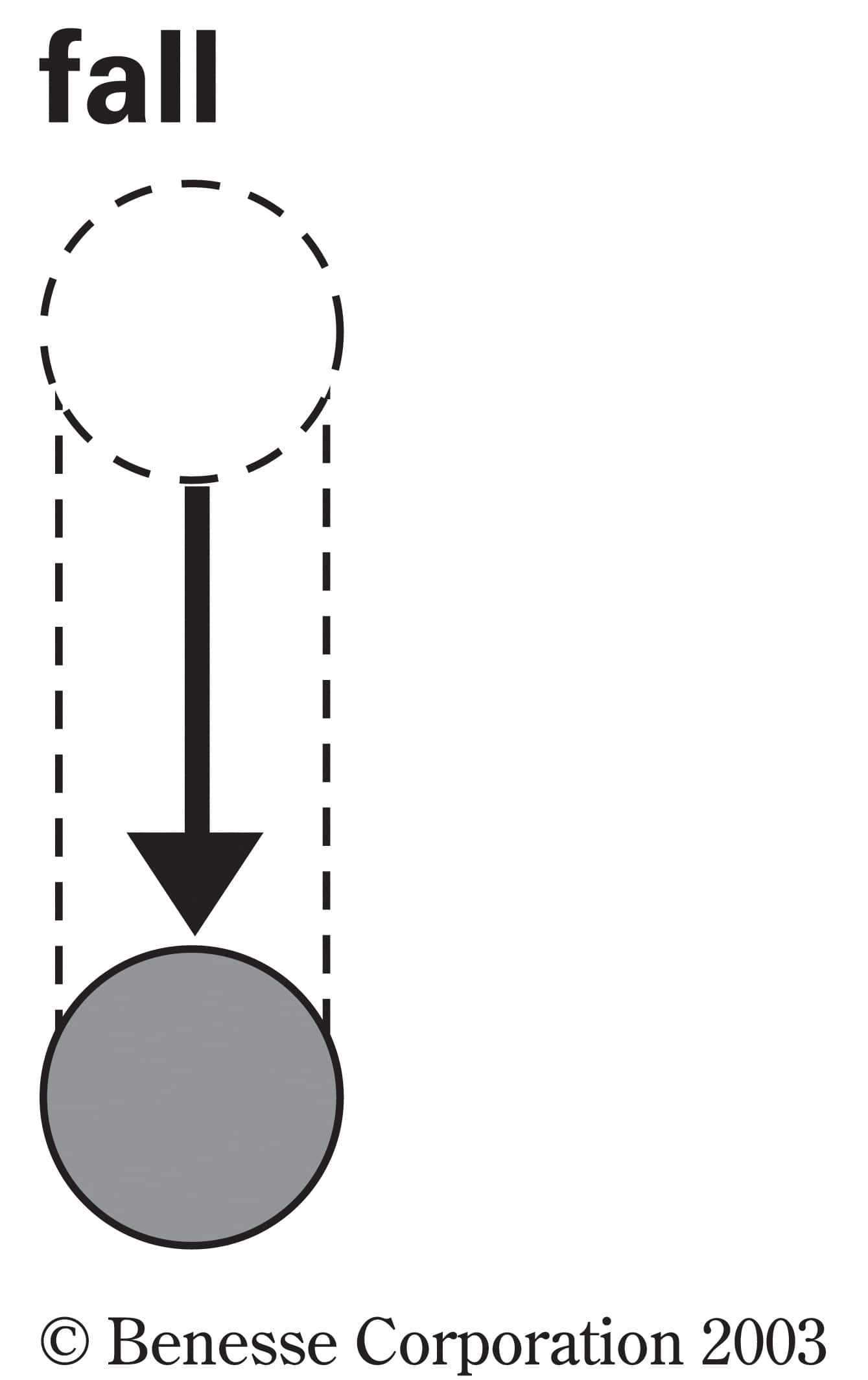 |
典型的には雨や落葉などの落下を表し,「倒れる」の意でも使われる |
Ⅰ落ちる動詞
├落ちる;降る▷1
├垂れる▷2
├傾斜する▷3
└沈む▷6
Ⅱ倒れる動詞
├倒れる▷7
└没落する▷8
Ⅲある状態まで落ちる動詞
└下がる▷11
秋▷名詞1
落下▷名詞2
滝▷名詞3
降雨[雪](量)▷名詞4
低下▷名詞7
転倒▷名詞8
├落ちる;降る▷1
├垂れる▷2
├傾斜する▷3
└沈む▷6
Ⅱ倒れる動詞
├倒れる▷7
└没落する▷8
Ⅲある状態まで落ちる動詞
└下がる▷11
秋▷名詞1
落下▷名詞2
滝▷名詞3
降雨[雪](量)▷名詞4
低下▷名詞7
転倒▷名詞8
動詞
自動詞
Ⅰ落ちる
1落ちる;(雨・雪などが)降る
2垂れる
3傾斜する
4((かたい))(夜のとばりが)降りる;(静寂が)訪れる
5(責任などが)〈…に〉かかる〈on〉;《it falls to a person to do》…する義務・責任が人にかかる
6(顔の表情が)(悲しみなどで)沈む,落胆する
Ⅱ倒れる
7倒れる,転ぶ
8没落する,陥落する
9((かたい))(戦場などで)倒れる,死ぬ
10((古))〈誘惑に〉負ける〈to/into〉
Ⅲある状態まで落ちる
11(価格・温度・声の高さなどが)下がる
12…の状態になる(形容詞・副詞・前置詞句を伴う)
1落ちる;(雨・雪などが)降る
2垂れる
3傾斜する
4((かたい))(夜のとばりが)降りる;(静寂が)訪れる
5(責任などが)〈…に〉かかる〈on〉;《it falls to a person to do》…する義務・責任が人にかかる
6(顔の表情が)(悲しみなどで)沈む,落胆する
Ⅱ倒れる
7倒れる,転ぶ
8没落する,陥落する
9((かたい))(戦場などで)倒れる,死ぬ
|
10((古))〈誘惑に〉負ける〈to/into〉
Ⅲある状態まで落ちる
11(価格・温度・声の高さなどが)下がる
12…の状態になる(形容詞・副詞・前置詞句を伴う)
成句fall about
((口))笑いころげる
成句fall apart
ばらばらになる;(関係が)壊れる
成句fall away
①減る,衰える,なくなる
②〈…から〉落ちる,外れる〈from〉
③(見捨てて)〈…から〉離れる〈from〉
成句fall back
後退する;(軍隊が)退却する
成句fall back on [upon] ...
…を(最後の)よりどころとする,…に頼る
成句fall behind
①((fall behind))遅れる,落伍する;〈仕事・支払いなどで〉遅れる〈in/with〉
成句fall down
①((fall down))〈…に〉倒れる〈on〉;(建物などが)崩壊する;((口))(人が)〈…に〉失敗する〈on〉
成句fall for ...
((口))…に夢中になる;…にだまされる
成句fall in
①(中に)崩れ落ちる
②≪軍≫整列する
成句fall into ...
①(ある状態)になる,陥る;…に落ちる,はまる
②…に分けられる;…に入る
成句fall in with ...
①(人)に偶然会う
②(人)の(悪い)仲間になる
③((英))(提案・計画など)に同意する
成句fall off
①((fall off))はずれて落ちる
②((fall off))減少する,衰える,(質などが)低下する
③((fall off ...))…から落ちる
成句fall on [upon] ...
①…に襲いかかる
②(義務・責任などが)…にかかる
③…を経験する
④(祭日・誕生日などが)…に当たる
⑤(視線が)…に留まる
成句fall out
①外側に落ちる
②〈人と〉〈…のことで〉けんかをする,口論する〈with〉〈over〉
③(計画などから)抜ける,降りる;≪軍≫隊列を離れる
④(歯・髪などが)抜ける
⑤(事が)起こる;((It falls out that ...))((かたい))(たまたま)…という結果になる
成句fall outside ...
(能力・範囲など)を越える
成句fall over
①((fall over ...))…につまずいて転ぶ
②((fall over))(ふらっと)倒れる
成句fall through
失敗する,だめになる
|
成句fall to
①((fall to))食べ始める;仕事・けんかなどを始める
②((fall to ...))…をするようになる
成句fall under ...
①…の部類に入る,…に含まれる
②…の影響を受ける,…の責任である
成句fall into line
⇒line名詞成句
名詞
Weblio実用英語辞典

fall
「fall」は「落ちる」「秋」「滝」などの意味を持つ英単語である。
名詞:秋、落下、減少、(通例~s)滝
1. The leaves fall from the trees in autumn.(秋になると木から葉が落ちる。)
2. The empire fell after a long war.(長い戦争の後、帝国は陥落した。)
3. He fell to the ground.(彼は地面に倒れた。)
4. Prices fall during a recession.(不況時には価格が下落する。)
5. Darkness fell over the city.(闇が街を覆った。)
1. Fall is the season of harvest.(秋は収穫の季節である。)
2. The fall of the meteorite was observed by many people.(その隕石の落下は多くの人々によって観測された。)
3. There was a significant fall in the stock market today.(今日、株式市場において顕著な下落があった。)
4. Niagara Falls is a famous tourist attraction.(ナイアガラの滝は有名な観光地である。)
5. The fall of the Roman Empire is a well-studied subject in history.(ローマ帝国の滅亡は歴史上よく研究されている主題である。)
「fall」とは・「fall」の意味
動詞:落ちる、陥落する、倒れる、減少する、下落する、(闇・光などが)おおう、陥る名詞:秋、落下、減少、(通例~s)滝
fallの用法
動詞
「fall」が動詞として使われる場合、物体が高い位置から低い位置へ移動すること、または何らかの状態から別の状態へ変化することを示す。具体的な例を以下に示す。
・例文1. The leaves fall from the trees in autumn.(秋になると木から葉が落ちる。)
2. The empire fell after a long war.(長い戦争の後、帝国は陥落した。)
3. He fell to the ground.(彼は地面に倒れた。)
4. Prices fall during a recession.(不況時には価格が下落する。)
5. Darkness fell over the city.(闇が街を覆った。)
名詞
「fall」が名詞として使われる場合、季節の秋、物体の落下、何かの減少、または滝を指す。具体的な例を以下に示す。
・例文1. Fall is the season of harvest.(秋は収穫の季節である。)
2. The fall of the meteorite was observed by many people.(その隕石の落下は多くの人々によって観測された。)
3. There was a significant fall in the stock market today.(今日、株式市場において顕著な下落があった。)
4. Niagara Falls is a famous tourist attraction.(ナイアガラの滝は有名な観光地である。)
5. The fall of the Roman Empire is a well-studied subject in history.(ローマ帝国の滅亡は歴史上よく研究されている主題である。)
コア・セオリー英語表現(基本動詞)

fall
| コアとなる意味 | 落下する |
| ポイント | 典型的には雨や落葉などの落下を表すが,垂れ下がった髪・衣服や(土地の)傾斜などについてもイメージの投影が起こる. |
⑤(顔・視線が)(落胆や悲しみなどの表情を帯びるために)下がる,落胆する
⑧死ぬ
- Her grandfather fell in battle.
彼女の祖父は戦死した
バラバラになる
fall back on [upon]...
①((fall behindで))遅れる, 落伍する
fall for...
②((fall offで))減少する, 衰える, (質などが)低下する
③経験する
①<人と><...のことで>けんかをする, 口論する<with><over>
②((It falls out thatで))(たまたま)...という結果になる
fall outside
((fall over...で))(...につまずいて))転ぶ;((fall overで))(ふらっと)倒れる
- The deal fell through at the last minute.
取り引きは土壇場でだめになってしまった
fall to...
fall under...
 l-
l-科学技術論文動詞集

fall
自動詞
落ちる- 原義は「落ちる」。一般的な用法の第一の意味は、「(高い所から低い所へ)落ちる、落下する」。科学技術論文では、1. fall in (into) 〜 で、外殻電子が内殻に「落ちて入る」、2. fall + 前置詞 で、(様々な)信号が、試料や装置の構成機器に「落ちる」というように使う。

日本語WordNet(英和)

fall
動詞
- 用例
- 用例
名詞
- 用例
Weblio英和対訳辞書
fall
下がる, 下る, 退がる, 転ける, 倒ける, 散る, 滅びる, 亡びる, 落ちる, 墜ちる, 落る, 落つ, 墜つ, 堕つ, 降る, 倒る, 斃る, 仆る, 殪る, ぶつかる, 倒れる, 斃れる, 仆れる, 殪れる, 堕ちる, 陥る, 落ち入る, 桜散る, さくら散る, サクラ散る, 落ちこぼれる, 落ち零れる, 褫く, 降りかかる, 降り掛かる, 降り懸かる, 降り掛る, 降り懸る, 降掛かる, 降懸かる, 降掛る, 降懸る, 振り掛かる, 蹌踉めく, 蹣跚めく, 注ぐ, 灌ぐ, 潅ぐ, 濺ぐ, 漑ぐ, 滅ぶ, 亡ぶ
関東弁落っこちる
関東弁落っこる
関東弁落っこちる
関東弁落っこる
fall
失墜, 失脚, 減り, 低減, 秋, フォール, 降下, 下押し, 凋落, 下落, 減収, 失陥, 破滅, 没落, 沒落, 落ち込み, 落込み, 転落, 顛落, 下がり, 低落, 下降, 陥落, 墜落, ダウン, 低下, 付け髷, 付けまげ, 秋日, 転倒, 顛倒, 落下, 草枯れ
fall
fall
fall (off)
Fall
ファル; フォール
Weblio英和対訳辞書はプログラムで機械的に意味や英語表現を生成しているため、不適切な項目が含まれていることもあります。ご了承くださいませ。
Wiktionary英語版
出典:Wiktionary
fall
出典:『Wiktionary』 (2026/07/18 17:46 UTC 版)
発音
語源 1
Verb from 中期英語 fallen, from 古期英語 feallan (“to fall, fail, decay, die, attack”), from Proto-West Germanic *fallan (“to fall”), from Proto-Germanic *fallaną (“to fall”), from Proto-Indo-European *h₃elh₁- (“to collapse, fall; to destroy”).
Sense of "autumn" is attested by the 1660s in England as a shortening of fall of the leaf (1540s), from the falling of leaves during this season. Along with autumn, it mostly replaced the older name harvest as that name began to be associated strictly with the act of harvesting. Compare spring, which began as a shortening of “spring of the leaf”.
動詞
fall (third-person singular simple present falls, present participle falling, simple past fell, past participle fallen)
- (heading, intransitive) To be moved downwards.
- To move to a lower position under the effect of gravity.
- To come down, to drop or descend.
-
2018 June 13, Rory Smith, “IQ scores are falling and have been for decades, new study finds”, in CNN:
-
The study not only showed IQ variance between children the same parents, but because the authors had the IQ scores of various parents, it demonstrated that parents with higher IQs tended to have more kids, ruling out the dysgenic fertility theory as a driver of falling IQ scores and highlighting the role of environmental factors instead.
-
- To come as if by dropping down.
- 1971, Henry Raup Wagner, Spanish Explorations in the Strait of Juan de Fuca:
- Shortly afterwards a breeze came up from the N […] dark clouds closing in over everything. At 3 in the afternoon the breeze came up from the S with a thick drizzle. Thus night fell, and thus we passed the rest of it.
- To come to the ground deliberately, to prostrate oneself.
- To be brought to the ground.
- To move to a lower position under the effect of gravity.
- (transitive) To move downwards.
- (intransitive) To change, often negatively.
- (copulative, in idiomatic expressions) To become (chiefly used with negative states).
- (intransitive) To collapse; to be overthrown or defeated.
- (intransitive, formal, euphemistic) To die, especially in battle or by disease.
- (intransitive) To become lower (in quantity, pitch, etc.).
-
1835, Sir John Ross, Sir James Clark Ross, Narrative of a Second Voyage in Search of a North-west Passage …, Vol.1, pages 284–5:
-
Towards the following morning, the thermometer fell to 5°; and at daylight, there was not an atom of water to be seen in any direction.
-
-
2013 July 20, “Old soldiers?”, in The Economist, volume 408, number 8845:
-
Whether modern, industrial man is less or more warlike than his hunter-gatherer ancestors is impossible to determine. […] One thing that is true, though, is that murder rates have fallen over the centuries, as policing has spread and the routine carrying of weapons has diminished. Modern society may not have done anything about war. But peace is a lot more peaceful.
-
- To occur (on a certain day of the week, date, or similar); to happen.
- (intransitive) To be allotted to; to arrive through chance, fate, or inheritance.
- (transitive, obsolete) To diminish; to lessen or lower.
-
1691, [John Locke], Some Considerations of the Consequences of the Lowering of Interest, and Raising the Value of Money. […], London: […] Awnsham and John Churchill, […], published 1692, →OCLC:
-
- (transitive, obsolete) To bring forth.
- (intransitive, obsolete) To issue forth into life; to be brought forth; said of the young of certain animals.
-
1869, William Youatt, Sheep: Their Breeds, Management, and Diseases, page 382:
-
another writer, adopting a similar opinion, affirms that it results from the lambs not being docked at a sufficiently early period; for "sometimes the ewe, in the ardour of her maternal affection, chews away the tail from her newly-fallen lamb, and none of these are afterwards affectd by the sturdy;
-
-
1892, United States. Bureau of Animal Industry, Special Report on the History and Present Condition of the Sheep Industry of the United States, page 422:
- (intransitive) To descend in character or reputation; to become degraded; to sink into vice, error, or sin.
- (intransitive) To become ensnared or entrapped; to be worse off than before.
- (intransitive) To assume a look of shame or disappointment; to become or appear dejected; said of the face.
- (intransitive) To happen; to come to pass; to chance or light (upon).
-
c. 1596–1598 (date written), William Shakespeare, “The Merchant of Venice”, in Mr. William Shakespeares Comedies, Histories, & Tragedies […] (First Folio), London: […] Isaac Iaggard, and Ed[ward] Blount, published 1623, →OCLC, [Act I, scene ii]:
-
[…] An the worst fall that ever fell, I hope I shall make shift to go without him.
-
-
1701, [Jonathan Swift], “Chapter I”, in A Discourse of the Contests and Dissensions between the Nobles and the Commons in Athens and Rome, with the Consequences They Had upon Both Those States, London: […] John Nutt […], →OCLC, page 9:
-
[…] Polybius tells us, the beſt Government is that which conſiſts of three Forms, Regno, Optimatium, & Populi imperio. Which may be fairly Tranſlated, the Kings, Lords and Commons. […] the Romans fell upon this Model purely by chance, (which I take to have been Nature and common Reaſon) but the Spartans by Thought and Deſign.
-
- 1879, Herbert Spencer, Principles of Sociology Volume II – Part IV: Ceremonial Institutions
- (intransitive) To begin with haste, ardour, or vehemence; to rush or hurry.
- 1881, Benjamin Jowett (Thucydides)
- (intransitive) To be dropped or uttered carelessly.
- (intransitive, of a fabric) To hang down (under the influence of gravity).
- (intransitive, slang, African-American Vernacular) To visit; to go to a place.
同意語
- (move to a lower position under the effect of gravity): drop, plummet, plunge
- (come down): come down, descend, drop
- (come to the ground deliberately): drop, lower oneself, prostrate oneself
- (be brought to the ground):
- (collapse; be overthrown or defeated): be beaten by, be defeated by, be overthrown by, be smitten by, be vanquished by,
- (die): die
- (be allotted to): be the responsibility of, be up to
- (become lower (in quantity, pitch, etc)): dip, drop
- (become): become, get
- (cause (something) to descend to the ground): cut down (of a tree), fell, knock down, knock over, strike down
反意語
派生語
- almost fall off one's chair, fall off one's chair, nearly fall off one's chair
- atfall
- befall
- bottom falls out
- catch a falling knife
- chip-fell-out-of-a-oak
- downfall
- easy as falling off a log
- fair fall
- fallable
- fall aboard
- fall aboard of
- fall about
- fall about someone's ears
- fall about the place
- fall abreast of
- fall abroad of
- fall across
- fall adown
- fall afire
- fall afoul
- fall afoul of
- fall after
- fallage
- fall all over someone or oneself
- fall among
- fall apart
- fall around
- fall asleep
- fall aslope
- fall astern
- fall asunder
- fall at
- fall at the crest
- fall at the final hurdle
- fall at the first fence, fall at the first hurdle
- fall at the last hurdle
- fall away
- fall-back
- fall back
- fall back, fall edge
- fall back into
- fall back on, fall back upon
- fall behind, fall behindhand
- fall below
- fall between the cracks
- fall between two stools
- fall by
- fall by the wayside
- fall calm
- fall classic
- fall dead
- fall down
- fall down on
- fall due
- fallen
- faller
- fall flat
- fall flat on one's face
- fall for
- fall forth
- fall foul
- fall foul of, fall foul with
- fall from
- fall from grace
- fall heir
- fall home
- fall ill
- fall in
- fall in age
- fall in flesh
- fall in for
- falling
- falling block
- falling in love
- falling off the bone
- falling-out
- falling out
- falling together
- fall in line
- fall in love
- fall in lust
- fall in mold, fall in mould
- fall in one's road
- fall in one's way
- fall in somebody's heart, fall in someone's heart
- fall in somebody's mind, fall in someone's mind
- fall into
- fall into a trap
- fall into line
- fall into oneself
- fall into one's hands
- fall into one's lap
- fall into place
- fall into somebody's heart, fall into someone's heart
- fall into somebody's mind, fall into someone's mind
- fall into someone's hands
- fall into someone's lap
- fall into the wrong hands
- fall in two
- fall in upon
- fall in with
- fall of
- fall off
- fall off a cliff
- fall off a truck
- fall off one's perch
- fall off the back of a lorry
- fall off the back of a truck
- fall off the cliff
- fall off the radar
- fall off the turnip truck
- fall off the wagon
- fall of the wall
- fall on
- fall on a grenade
- fall on board
- fall on deaf ears
- fall one's crest
- fall on hard times
- fall on one's face
- fall on one's feet
- fall on one's knees
- fall on one's sword
- fall on shore
- fall on sleep
- fall on someone's neck
- fall on stony ground
- fall on the crest
- fall open
- fall out
- fall out in
- fall out of
- fall out of favor
- fall out of love
- fall out upon
- fall out with
- fall over
- fall over oneself
- fall over one's feet
- fall pregnant
- fall prey
- fall prey to
- fall short
- fall short of
- fall short to
- fall sick
- fall silent
- fallstreaks
- fallstreifen
- fall through
- fall through the cracks
- fall through the floor
- fall to
- fall to be
- fall to bits
- fall together
- fall to loggerheads
- fall to mold, fall to mould
- fall to oneself
- fall to one's knees
- fall to one's lot
- fall to one's share
- fall to pieces
- fall to powder
- fall to someone's lot
- fall to the ground
- fall under
- fall unto
- fall up
- fall upon
- fall upon someone's neck
- fall victim to
- fall what can fall, fall what will fall
- fall with
- fall within
- fell (verb, as in “to fell a tree”, “to fell an opponent”)
- foul fall
- he who digs a pit for others falls in himself
- how the mighty have fallen
- let fall
- let the chips fall where they may
- let the dice fall where they may
- like falling off a log
- may fall
- may-fall
- misfall
- of-fall
- overfall
- refall
- scales fall from someone's eyes
- spring forward, fall back
- tendency of the rate of profit to fall
- the apple does not fall far from the stem
- the apple does not fall far from the tree, the apple doesn't fall far from the tree, the apple never falls far from the tree
- the apple does not fall far from the trunk
- the bigger they are, the harder they fall, the bigger they come, the harder they fall
- the curtain falls
- the nut does not fall far from the tree
- the rain in Spain falls mainly in the plain
- the sky fell in
- the sky will fall on your head
- to-fall
- trust-falling
- under-fall
- united we stand, divided we fall
- until the wheels fall off
名詞
fall (countable and uncountable, plural falls)
- The act of moving to a lower position under the effect of gravity.
- A reduction in quantity, pitch, etc.
- (chiefly Canada, US, archaic in Britain) The time of the year when the leaves typically fall from the trees; autumn; the season of the year between the autumnal equinox and the winter solstice. [from 16th c.]
-
1816, John Pickering, A Vocabulary, or Collection of Words Which Have Been Supposed to Be Peculiar to the United States of America:
-
A friend has pointed out to me the following remark on this word: "In North America the season in which this [the fall of the leaf] takes place, derives its name from that circumstance, and instead of autumn is universally called the fall." [brackets in original]
-
-
- A waterfall.
- A loss of greatness or status.
- That which falls or cascades.
- The height of that which falls or cascades.
- (sports) A crucial event or circumstance.
- A hairpiece for women consisting of long strands of hair on a woven backing, intended primarily to cover hair loss.
-
2004, Zoe Diana Draelos, Hair Care: An Illustrated Dermatologic Handbook, →ISBN, page 202:
-
Female patients with localized hair loss on the top of scalp could select a fall or a demiwig to camouflage crown and anterior scalp loss.
-
-
- (informal, US) Blame or punishment for a failure or misdeed.
- (nautical) The part of the rope of a tackle to which the power is applied in hoisting (usu. plural).
-
1919, Joseph Conrad, Typhoon:
-
"[...] with one overhauled fall flying and an iron-bound block capering in the air."
-
- An old Scots unit of measure equal to six ells.
- A short, flexible piece of leather forming part of a bullwhip, placed between the thong and the cracker.
- The lid, on a piano, that covers the keyboard.
使用する際の注意点
同意語
反意語
派生語
- accidental fall
- airfall
- angle of fall
- ashfall, ash fall
- backfall
- bergfall
- be riding for a fall
- best-of-three-falls match
- block and fall
- break a fall
- breakfall, break-fall
- break one's fall
- brothfall
- byfall
- catfall
- center of falls, centre of falls
- chainfall
- cliff fall
- cloudfall
- crossfall
- darkfall
- deadfall
- deadfall, dead-fall, dead fall
- dewfall, dew-fall
- dirtfall
- dogfall, dog-fall
- downfall
- dustfall
- earthfall
- evenfall, even-fall
- fall-and-rise phenomenon
- fall and tackle
- fall armyworm
- fall-back
- fall-block, fall block
- fall-blooming
- fallboard, fall-board
- fall break
- fall-breaker
- fall-bridge
- fall cankerworm
- Fall Classic
- fall-cloud
- fall colors (US)
- Fall Creek
- fall dandelion
- fall-door
- fall duck
- fall dwindle disease
- fall equinox
- fall factor
- fallfish, fall-fish
- fall foliage
- fall-forward
- fall from grace
- fall front
- fall-front desk
- fall-guy, fall guy
- fall herring
- fall-iron door
- fallish
- fall-leaf
- fall-less
- fall-like
- fall-line, fall line
- fall money
- fall of day
- fall of man, Fall of Man
- fall of shot
- fall of the leaf
- fall of the perch
- fall of wicket
- fallout
- fall overturn
- fall-pipe
- fall-pippin
- fall plate
- fall rate
- fallrate
- fall-rise
- Fall River
- fall-rope
- fall-run fish
- falls
- Falls-to-Falls Corridor
- fallstreak
- fall supper
- fall-through
- falltide
- falltime, fall time
- fall-trap
- fall turnover
- fallway
- fall-way
- fallwear
- fall webworm
- fall-wind, fall wind
- fall-window
- fall woman
- fall-wood
- fally
- fall zone
- firefall
- fish fall
- flagfall
- fogfall
- food fall
- footfall, foot-fall
- forcefall
- freefall
- free fall
- fruit fall
- fussefall
- give a fall
- grainfall
- hailfall
- hairfall
- icefall
- ice-fall, ice fall
- infall
- iron fall
- jawfall, jaw-fall
- landfall
- lavafall
- law-fall
- leaffall, leaf-fall
- litterfall
- mainfall
- midfall, mid-fall
- misfall
- mistfall
- moonfall
- mouse-fall
- mousefall
- near-fall
- nearfall
- nightfall
- no fall zone
- nutfall
- offal
- onfall
- outfall
- overfall
- parachute landing fall
- penny fall
- pinfall
- pitfall
- planetfall
- pratfall, prat-fall, pratt-fall
- prefall
- pressure-fall center, pressure-fall centre
- pride comes before a fall, pride goes before a fall, pride goeth before a fall
- proudfall
- rainfall
- rat-fall
- ride for a fall
- rises and falls
- rockfall, rock fall
- roof fall
- root-fall
- sandfall
- shake a fall
- shortfall
- shout-and-fall
- slip and fall
- smokefall
- snowfall, snow-fall
- spatfall
- speck falls
- starfall
- stiff board fall
- stonefall
- sunfall
- Swedish fall
- tackle fall
- take a fall
- take a fall out of
- take the fall
- technical fall
- terminal fall velocity
- the Fall of Baghdad
- the Fall of Constantinople
- the Fall of France
- the Fall of Saigon
- the Fall of the Roman Empire, the Fall of Rome
- threadfall
- throughfall
- tidefall
- toe drain and outfall
- tofall
- trad fall
- trapfall, trap-fall
- treefall
- trust fall
- try a fall
- two-out-of-three-falls match
- underfall
- waterfall
- whale fall
- whalefall
- windfall
- withfall
- wrestle a fall
- wrist-fall
- zipper fall
参考
語源 2
Perhaps from the north-eastern Scottish pronunciation of whale.
派生語
- loose fall
参照
- ^ Williams, Zoe (14 June 2022), “The young fall over, older people ‘have a fall’ – and my stepmother is none too happy about it”, in The Guardian
- ^ Harayada, Janice (12 November 2023), “Are We Talking About Falls The Wrong Way?”, in Crow's Feet
Weblio例文辞書
fall
1
例文
2
例文
3
例文
4
例文
5
例文
6
例文
7
例文
例文
9
汚すさま
例文
10
例文
11
例文
12
例文
14
例文
15
16
例文
burls
20
口うるさいさま
例文
22
例文
23
例文
24
例文
25
例文
26
27
28
29
落成する
Weblio例文辞書はプログラムで機械的に意味や英語表現を生成しているため、不適切な項目が含まれていることもあります。ご了承くださいませ。
fall-
1
例文
例文
3
例文
4
例文
5
汚すさま
例文
例文
7
例文
例文
例文
burls
10
例文
例文
12
例文
13
口うるさいさま
例文
14
例文
wrens
例文
16
例文
rudds
例文
a paste-pot
18
例文
19
例文
to fall upon another person
20
例文
21
例文
22
23
例文
the instep
24
例文
25
例文
26
例文
a wrinkle
28
例文
例文
30
例文
Weblio例文辞書はプログラムで機械的に意味や英語表現を生成しているため、不適切な項目が含まれていることもあります。ご了承くださいませ。


- Copyright (c) 1995-2026 Kenkyusha Co., Ltd. All rights reserved.
- Copyright © Benesse Holdings, Inc. All rights reserved.
- Copyright (C) 2026 田中茂範 All rights reserved.

- © 2000 - 2026 Hyper Dictionary, All rights reserved

- Copyright © 2026 JILI. All rights reserved.

- Copyright (C) 1994- Nichigai Associates, Inc., All rights reserved.
- Copyright(C)1996-2026 JEOL Ltd., All Rights Reserved.

- Copyright (C) 1994- Nichigai Associates, Inc., All rights reserved.

- Copyright (C) 2026 安藤設計事務所 All rights reserved.

- ※この記事は「日本法令外国語訳データベースシステム」の2010年1月現在の情報を転載しております。

- All Rights Reserved, Copyright © Japan Science and Technology Agency


- ※この記事は『「多国語防災用語集」国際防災の十年(IDNDR)国民会議』の内容を転載しております。
- Copyright (c) The Japanese Society of Parasitology

- ©日本集団災害医学会2026

- Copyright (C) 2026 ライフサイエンス辞書プロジェクト
- 日本語ワードネット1.1版 (C) 情報通信研究機構, 2009-2010 License All rights reserved.
WordNet 3.0 Copyright 2006 by Princeton University. All rights reserved. License

- Copyright(C)2002-2026 National Institute of Information and Communications Technology. All Rights Reserved.

- Copyright © 2026 CJKI. All Rights Reserved

- Copyright © 2026 CJKI. All Rights Reserved

- Copyright (C) 1994- Nichigai Associates, Inc., All rights reserved.
「斎藤和英大辞典」斎藤秀三郎著、日外アソシエーツ辞書編集部編
- Wiktionary
- Text is available under Creative Commons Attribution-ShareAlike (CC-BY-SA) and/or GNU Free Documentation License (GFDL).
Weblio英和・和英辞典に掲載されている「Wiktionary英語版」の記事は、Wiktionaryのfall (改訂履歴)の記事を複製、再配布したものにあたり、Creative Commons Attribution-ShareAlike (CC-BY-SA)もしくはGNU Free Documentation Licenseというライセンスの下で提供されています。
- CMUdict
- CMUdict is Copyright (C) 1993-2008 by Carnegie Mellon University.
